Home Insurance, coverage types
Flood Insurance NFIP Guide: What the National Flood Insurance Program Covers, What It Costs, and What It Does Not Cover
Floods are the most common natural disaster in the United States — and a standard homeowners policy does not cover them. Here is what the federal flood program covers, what it costs, and where its gaps are.
- By
- Ella H.
- Published
- Updated
- Reading time
- 16 min read
Key takeaways
- A standard homeowners policy does not cover flood damage. Only a separate flood policy — from the NFIP or a private insurer — covers it.
- The NFIP caps residential coverage at $250,000 for the building and $100,000 for contents, and contents are paid at actual cash value only, not replacement cost.
- The national average NFIP premium in 2026 is about $976 a year, or about $81 a month, according to NerdWallet's analysis of NFIP data — but your price depends on your own home's risk, not on the average.
- An NFIP policy normally takes 30 days to go into effect, with two exceptions FEMA names: coverage bought because a lender requires it, and coverage bought after a community flood map change.
- The NFIP does not pay for temporary housing, finished basements, or most outdoor property — the three gaps that surprise homeowners most after a flood.
In this guide
- Your homeowners policy does not cover floods
- What the NFIP covers: the $250,000 and $100,000 limits
- How much flood insurance costs in 2026
- Risk Rating 2.0: why your neighbor pays a different price
- The 30-day waiting period — and the two exceptions
- What the NFIP does NOT cover
- NFIP vs. private flood insurance
- Who should buy flood insurance — and how to buy it
- The bottom line
- Frequently asked questions
- Sources
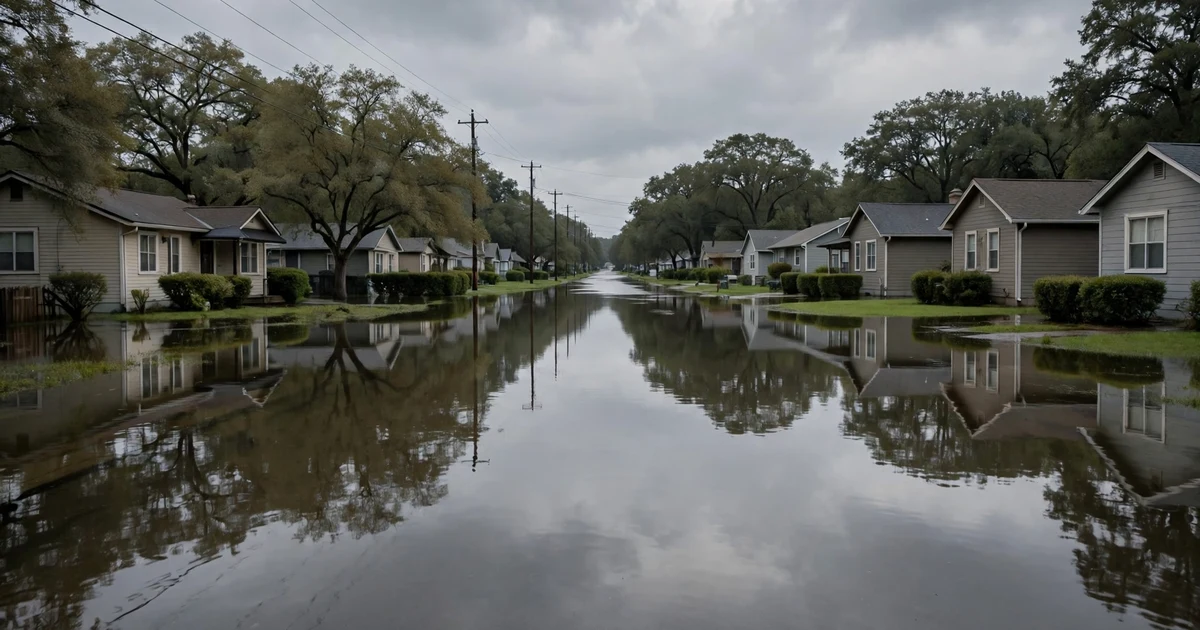
Floods are involved in 90% of all natural disasters in the United States 1. A river can overflow after a storm, a flash flood can run down a street that has never flooded before, and a heavy rain can push water into a home in minutes. Most homeowners discover one hard fact only after the water is gone: a standard homeowners policy does not cover flood damage 1 2. Only a separate flood policy covers it — either from the federal National Flood Insurance Program, known as the NFIP, or from a private insurer 3.
That gap matters because floods do not stay where the maps say they should. Almost one-third of NFIP flood insurance claims come from outside high-risk flood areas 1. The NFIP itself reports that 29% of its claims come from properties outside the high-risk zones 3. If you think your home is safe because it is not near a river or the coast, those numbers say otherwise. Water finds low ground, and low ground exists in almost every town.
This guide explains the NFIP in simple words: what it covers and what it does not, what it costs in 2026, why your price may be very different from your neighbor's, the 30-day waiting period, and when a private policy is worth a look. Every number in this guide comes from a named source, and the cost figures are dated to 2026, because flood insurance prices have changed a lot in the last few years.
Your homeowners policy does not cover floods
A standard homeowners policy covers damage from fire, wind, hail, and many other perils. It does not cover damage from a flood, and neither does a standard renters policy 3. The same is true of most other home insurance: water that comes from inside the home — a burst pipe, for example — is a different kind of claim and may be covered, but water that rises from outside and enters the home is a flood, and floods are excluded 1.
The distinction confuses many homeowners, so it is worth stating plainly. If rain comes through a damaged roof, that is usually a homeowners claim. If a river overflows or heavy rain floods the ground floor, that is a flood claim, and a homeowners policy will not pay it. The only way to insure against that kind of damage is a separate flood policy.
The NFIP is the federal program that sells most flood insurance in the United States. It is run by the Federal Emergency Management Agency, known as FEMA. The program has about 4.7 million policyholders and nearly $1.3 trillion in coverage in force 1. You can buy an NFIP policy if you live in one of the 22,600 participating communities — a community that has agreed to manage its flood risk under the program's rules 1. More than 47 private companies sell and service NFIP policies, so in practice you usually buy one through an insurance agent 1.
Homes in high-risk flood areas with a mortgage from a government-backed lender are required to have flood insurance 1. Everyone else can buy it voluntarily. The question is whether the NFIP's limits are enough for your home, and whether its price makes sense for your risk. The next sections take those questions one at a time.
What the NFIP covers: the $250,000 and $100,000 limits
| Coverage | NFIP limit (home) |
|---|---|
| Building (the structure) | $250,000 |
| Contents (your belongings) | $100,000 |
Source: Insurance Information Institute and FEMA 3 2.
Those two numbers are the heart of the NFIP. For a home, building coverage tops out at $250,000, and contents coverage tops out at $100,000, and the two are sold separately — you can buy building coverage, contents coverage, or both 3 2. Commercial buildings have higher limits: $500,000 for the building and $500,000 for contents 3.
The building limit covers the structure itself: walls, floors, roof, foundation, built-in appliances, and the systems that make the home work, such as electrical wiring and plumbing. The contents limit covers your belongings: furniture, clothing, electronics, and other personal property inside the home.
But there is a catch that changes how much you actually receive after a flood. The building is paid at replacement cost — what it costs to rebuild or repair it with new materials. Contents, on the other hand, are paid at actual cash value only — what the item is worth today, after subtracting depreciation for age and wear 3. A ten-year-old sofa, for example, is not worth what you paid for it, and the NFIP pays only its depreciated value. That difference is one of the main reasons people compare private flood policies, which often pay contents at replacement cost instead — more on that below.
The $250,000 building limit is the other reason to think carefully. If your home would cost $400,000 to rebuild, an NFIP policy can pay at most $250,000 of that, and the rest comes out of your pocket. The NFIP limit has not kept pace with rising construction costs, and for an expensive home it may not be enough. In that case a private policy, which can offer higher building limits, may be the only way to close the gap.
How much flood insurance costs in 2026
The national average NFIP premium in 2026 is about $976 a year, or about $81 a month 4. That figure comes from NerdWallet's analysis of 2026 NFIP data: total written premium divided by the number of policies in force, including the mandatory federal policy fee, and including both residential and commercial policies. The method matters, and it is worth stating, because different analyses count different groups of policies and arrive at different averages. The $976 figure is the average for all NFIP policies, not the average for a single-family home alone.
Your own price will almost certainly be different from the national average, because flood insurance is priced home by home. Two homes on the same street can pay very different premiums if one sits higher, farther from water, or on a different foundation. The zone averages show how much location matters:
| Flood zone | Average NFIP premium, 2026 |
|---|---|
| High-risk (A or V zones) | $1,114 a year ($93 a month) |
| Low or moderate risk (all other zones) | $745 a year ($62 a month) |
Source: NerdWallet analysis of 2026 NFIP data 4.
The gap between the two zones is about $369 a year. That is real money, but it is smaller than many people expect — and it reflects a deliberate change in how the NFIP prices risk, which the next section explains.
Prices also vary sharply by state. The lowest state average in 2026 is Alaska, at $428 a year. The highest is West Virginia, at $1,840 a year. Florida, the state most people associate with flood risk, averages $938 a year — close to the national average 4. Those state figures are averages across every policy in the state, so they hide wide differences between individual homes. A house on high ground in Florida can cost far less than the state average, and a house in a low-lying valley in West Virginia can cost far more.
The practical lesson is simple: do not budget from the national average. Get a quote for your own address. The quote is free, and it is the only number that tells you what you would actually pay.
Risk Rating 2.0: why your neighbor pays a different price

Until recently, the NFIP priced a home mostly by its flood zone — a broad area on a map. That changed with Risk Rating 2.0, the program's new pricing system. Under Risk Rating 2.0, each home is priced on its own risk: how often floods happen nearby and what kind of flooding it is, how far the home sits from water, the elevation of the home and the height of its first floor, what it would cost to rebuild, and the foundation and building traits of the house 4.
The rollout happened in stages. Risk Rating 2.0 started in October 2021 for new policies, applied to renewals from April 1, 2022, and was fully in effect from April 1, 2023 4. By now, in November 2026, every NFIP policy is priced under the new system.
The change made prices fairer in one sense and harder to predict in another. Two homes in the same flood zone can now pay very different premiums, because the system looks at the individual house — its elevation, its distance from water, its rebuilding cost — instead of the zone alone. That is why the zone averages above are only a rough guide, and why a quote for your own address is the only reliable price.
The new system also moved prices in both directions. Premiums dropped for about 23% of existing policyholders when Risk Rating 2.0 took effect, while everyone else paid the same or more, according to FEMA 4. For homes whose risk was previously underpriced, the increases were phased in rather than applied all at once.
That phasing has a legal limit. In most cases, federal law caps annual NFIP premium increases at 18% a year 4. So if your true risk-based price is much higher than what you pay today, the NFIP raises it by up to 18% a year until it reaches the full price. That glide path can take years, and it means your premium may keep rising even if nothing about your home changes. Exceptions exist for some properties, such as vacation homes and properties with multiple severe flood claims, where higher caps can apply 4.
There is one more way to lower the price, and it depends on where you live rather than on your house. The Community Rating System gives discounts of 5% to 45% off NFIP premiums, depending on how well your community manages flood risk — things like public information, mapping, and floodplain rules 4. Ask your agent whether your community takes part and what discount class it holds. You cannot change your community's class on your own, but the discount is already built into your quote if your community earns one.
The 30-day waiting period — and the two exceptions
An NFIP policy normally takes 30 days to go into effect 1. That is the single most important timing rule in flood insurance, and the one that causes the most denied claims. If you buy a policy today, you are not covered for a flood that happens tomorrow, or next week, or in three weeks. You are covered starting on day 31.
That rule exists for an obvious reason: without it, people would buy flood insurance only when a storm was already on the way, and the program could not work. But it means flood insurance is something you buy before you need it, not when the forecast turns bad. If a hurricane is forming offshore and you do not already have a policy, it is already too late for this storm. The time to buy is on a dry, sunny day, when flooding feels far away.
FEMA's own pages confirm that exceptions exist, and they name two of them: coverage bought because a government-backed lender requires it, and coverage bought after a community flood map change 1. In those cases the waiting period is shorter — but the exact day counts for the exceptions are not stated on the FEMA pages this guide relies on, so this guide does not print them as exact rules. If either situation applies to you, ask your agent or lender for the exact timing in writing before you count on it.
The practical rule is simple either way: do not wait for the forecast. If you are thinking about flood insurance, buy it now, while the sky is clear. The 30 days will pass, and the coverage will be in place when the next storm arrives.
What the NFIP does NOT cover

The NFIP's exclusions are where most surprises live. A policy can pay for the structure and still leave you with thousands of dollars in costs you expected it to cover. These are the three gaps that cause the most trouble:
Temporary housing is not covered. The NFIP does not pay additional living expenses — the cost of a hotel, a rental, or meals while your home is unlivable after a flood 5. If a flood forces you out of your home for a month while it dries out and is repaired, the NFIP pays for the repairs, but not for the place you sleep while they happen. That cost comes from your savings, or from a private policy that includes living-expenses coverage.
Basements are sharply limited. Coverage in basements and below-grade areas covers only essential systems and equipment — a furnace, a water heater, an electrical panel, a sump pump, and similar items 5. Finished walls and floors in a basement are generally not covered, and personal belongings stored in a basement are generally not covered either 5. If you have turned your basement into a living room, a bedroom, or a home office, the NFIP will not pay to rebuild that finished space, and it will not pay for the furniture and electronics stored down there. Move valuables out of the basement if you can, and do not count on the policy to replace what stays.
Outdoor property is mostly not covered. Decks, patios, fences, landscaping, and items stored outside the home are generally outside NFIP coverage. The policy is built around the building and the belongings inside it. If your yard, your fence, or your patio is damaged by floodwater, expect to pay for that yourself unless a private policy says otherwise.
There is one more limit worth knowing, because it is a benefit rather than an exclusion. Increased Cost of Compliance, known as ICC, pays up to $30,000 toward elevating, demolishing, or relocating a home after a qualifying flood, when local building rules require the home to be brought up to current flood standards 5. If your town says a badly damaged home must be raised before it can be rebuilt, ICC helps pay for that work. It is a small amount next to the cost of raising a house, but it is real money that many homeowners never hear about until they need it.
Read the exclusions before you buy, not after a flood. Ask your agent to walk through the basement and living-expenses limits with you, and ask what a private policy would add. The cheapest policy is not always the best value if its gaps are the ones you are most likely to hit.
NFIP vs. private flood insurance
| NFIP | Private flood insurance | |
|---|---|---|
| Building limit | $250,000 | Higher limits available — varies by carrier |
| Contents limit | $100,000 | Higher limits available — varies by carrier |
| Contents paid at | Actual cash value only | Often replacement cost — varies by carrier |
| Living expenses | Not covered | May be included — varies by carrier |
| Basement coverage | Limited to essential systems | Broader in some policies — varies by carrier |
| Waiting period | 30 days (with two exceptions) | Set by the carrier, may be shorter — varies by carrier |
| Who sells it | Through agents; serviced by 47+ companies | Directly from private insurers |
Sources: FEMA, the Insurance Information Institute, and NerdWallet; every private-policy claim in this table varies by carrier 1 3 4.
The table shows the real trade-off. The NFIP is the standard, widely available option, and it is the only option in some areas. Its limits are fixed, its contents are paid at depreciated value, and it does not cover living expenses. A private policy can fix each of those gaps: higher building limits that match the true rebuilding cost, contents at replacement cost, living expenses while you are out of the home, and a waiting period that may be shorter than 30 days. The catch is that every one of those private benefits varies by carrier — there is no single private standard to compare against, so you have to read the actual policy and get a real quote 4.
One rule makes the comparison practical. Since July 1, 2019, mortgage lenders must accept a qualifying private flood policy, so choosing private cover does not put your mortgage at risk if the policy meets the requirements 4. If you have a lender-required policy, ask your lender what it needs to see in a private policy before you switch.
Private flood insurance is not always cheaper, and it is not always available — some insurers will not write a policy for a very high-risk home, while the NFIP must take it. But for a home worth more than $250,000 to rebuild, or for a homeowner who wants contents at replacement cost and living expenses covered, a private quote is worth getting alongside the NFIP quote. Compare the two side by side, line by line, and look at the exclusions as closely as the limits.
Who should buy flood insurance — and how to buy it
The honest answer is broader than most people think. If your home is in a high-risk flood zone and you have a mortgage from a government-backed lender, you must buy it 1. That is the requirement, not a choice. But the 29% of claims that come from outside high-risk areas are the reason the question does not stop there 3. A home outside the high-risk zone is cheaper to insure — $745 a year on average, against $1,114 in a high-risk zone — and it is still at risk 4. Heavy rain, a clogged storm drain, a creek that overflows once in a decade: none of those respect a zone boundary.
Start by finding out your home's flood risk. FEMA's FloodSmart site lets you look up your address and see whether your community takes part in the NFIP 1. Your insurance agent can run a quote and tell you the zone, the price, and the Community Rating System discount your community earns, if any. Get the quote in writing, with the building and contents limits shown separately, and check the waiting period start date — the 30 days begin when the policy is issued, not when you first think about buying.
Finally, keep the policy continuous. A lapse means a new 30-day waiting period, and a lapse during storm season means no coverage when you need it most. Set the renewal on autopay if you can, and check at each renewal whether your premium has moved — under Risk Rating 2.0, the 18% annual cap means your price can rise year after year until it reaches the full risk-based level 4. Knowing that in advance is better than finding out from a renewal bill.
Verified against FEMA FloodSmart and the NFIP limits pages, the Insurance Information Institute flood insurance guide, and NerdWallet's 2026 NFIP cost analysis on November 21, 2026.
The bottom line
A standard homeowners policy does not cover flood damage, and floods are involved in 90% of all natural disasters in the United States — including floods in places the maps call low risk, which produce 29% of NFIP claims 1 3. The NFIP is the main way Americans insure against that risk: up to $250,000 for the building at replacement cost and $100,000 for contents at actual cash value, for a national average of about $976 a year in 2026, with prices set home by home under Risk Rating 2.0 4. Buy it before you need it, because the 30-day waiting period means a policy bought on the eve of a storm covers nothing 1. And read the exclusions before you sign: no living expenses, sharply limited basement cover, and a $250,000 cap that may fall short of rebuilding an expensive home. If any of those gaps worries you, get a private quote alongside the NFIP one and compare them line by line — the right policy is the one whose gaps you understand and can live with.
Frequently asked questions
- Does homeowners insurance cover flood damage?
- No. A standard homeowners policy does not cover damage from flooding, and neither does a standard renters policy. Flood damage is covered only by a separate flood insurance policy, either from the federal National Flood Insurance Program (NFIP) or from a private insurer.
- How much does NFIP flood insurance cost?
- The national average NFIP premium in 2026 is about $976 a year, or about $81 a month, according to NerdWallet's analysis of 2026 NFIP data covering all policies, including commercial ones. Prices vary widely by home: high-risk zones average $1,114 a year, while low- and moderate-risk zones average $745 a year.
- What are the NFIP coverage limits?
- For a home, the NFIP caps building coverage at $250,000 and contents coverage at $100,000. Building coverage is paid at replacement cost, but contents are paid at actual cash value only, which subtracts depreciation. Commercial buildings have higher limits of $500,000 for the building and $500,000 for contents.
- How long is the NFIP waiting period?
- An NFIP policy normally takes 30 days to go into effect. FEMA names two exceptions: coverage bought because a government-backed lender requires it, and coverage bought after a community flood map change. You cannot buy a policy the day a storm is coming and expect it to cover that storm.
- Does NFIP flood insurance cover basements and temporary housing?
- Mostly no. Coverage in basements and below-grade areas is sharply limited to essential systems and equipment, such as a furnace, water heater, electrical panel, and sump pump. Finished walls and floors and personal items stored in a basement are generally not covered. The NFIP also does not pay additional living expenses or temporary housing.
- Is private flood insurance better than the NFIP?
- It depends on your home. Private policies can offer higher building limits than the NFIP's $250,000 cap, contents at replacement cost instead of actual cash value, and extras such as living expenses — but the details vary by carrier. Since July 1, 2019, lenders must accept a qualifying private flood policy, so you can compare both.
Sources
Numbers in the text point to these publications. Links open the original source.
- Federal Emergency Management Agency (FEMA). Flood insurance (FloodSmart.gov)
- Federal Emergency Management Agency (FEMA). NFIP flood insurance coverage limits
- Insurance Information Institute (Triple-I). Facts about flood insurance
- NerdWallet. How Much Does Flood Insurance Cost?
- MoneyGeek. What Does Flood Insurance Cover? (And What It Doesn't)
Related guides
- Does Homeowners Insurance Cover Flood Damage? NFIP, Costs and the 30-Day Wait
No, a standard homeowners policy excludes flood damage. Flood coverage comes from a separate NFIP or private policy, with a 30-day waiting period.
- What Does Homeowners Insurance Cover? (And What It Does Not Cover)
A standard homeowners policy covers your dwelling, other structures, belongings, living expenses, and liability — but not floods or earthquakes.
- How Much Does Homeowners Insurance Cost? Average Rates by State
The official NAIC average HO-3 premium was $1,737 a year in 2023 data, while modeled 2026 quotes average $2,490 for $400,000 of dwelling coverage.
This guide is general educational information, not insurance, legal or financial advice. Insurance rules and prices vary by state, company and personal circumstances. Confirm anything important with your state insurance department or a licensed professional. Read the full disclaimer.