Home Insurance, coverage types
Does Homeowners Insurance Cover Flood Damage? NFIP, Costs and the 30-Day Wait
The answer is no, and it is the most expensive misunderstanding in homeowners insurance. Flood damage needs its own policy, and that policy usually takes 30 days to take effect.
- By
- Ella H.
- Published
- Updated
- Reading time
- 12 min read
Key takeaways
- A standard homeowners policy excludes flood damage entirely. Flood coverage is a separate policy.
- The NFIP covers up to $250,000 for the building and $100,000 for contents for a residential property.
- A new NFIP policy usually takes effect 30 days after purchase, with four exceptions, including no wait at a mortgage closing.
- Flood insurance is required when a federally regulated loan covers a building in a high-risk flood zone.
- About 29% of NFIP claims over the past 10 years came from outside high-risk flood zones.
In this guide
- What counts as a flood
- Why homeowners insurance excludes floods
- What the NFIP covers, and its limits
- The 30-day waiting period and its four exceptions
- Who is required to buy flood insurance
- Basement coverage: the fine print that hurts
- How NFIP claims work
- How flood insurance is priced: Risk Rating 2.0
- NFIP vs private flood insurance
- What changed in 2026
- Frequently asked questions
- The bottom line
- Frequently asked questions
- Sources
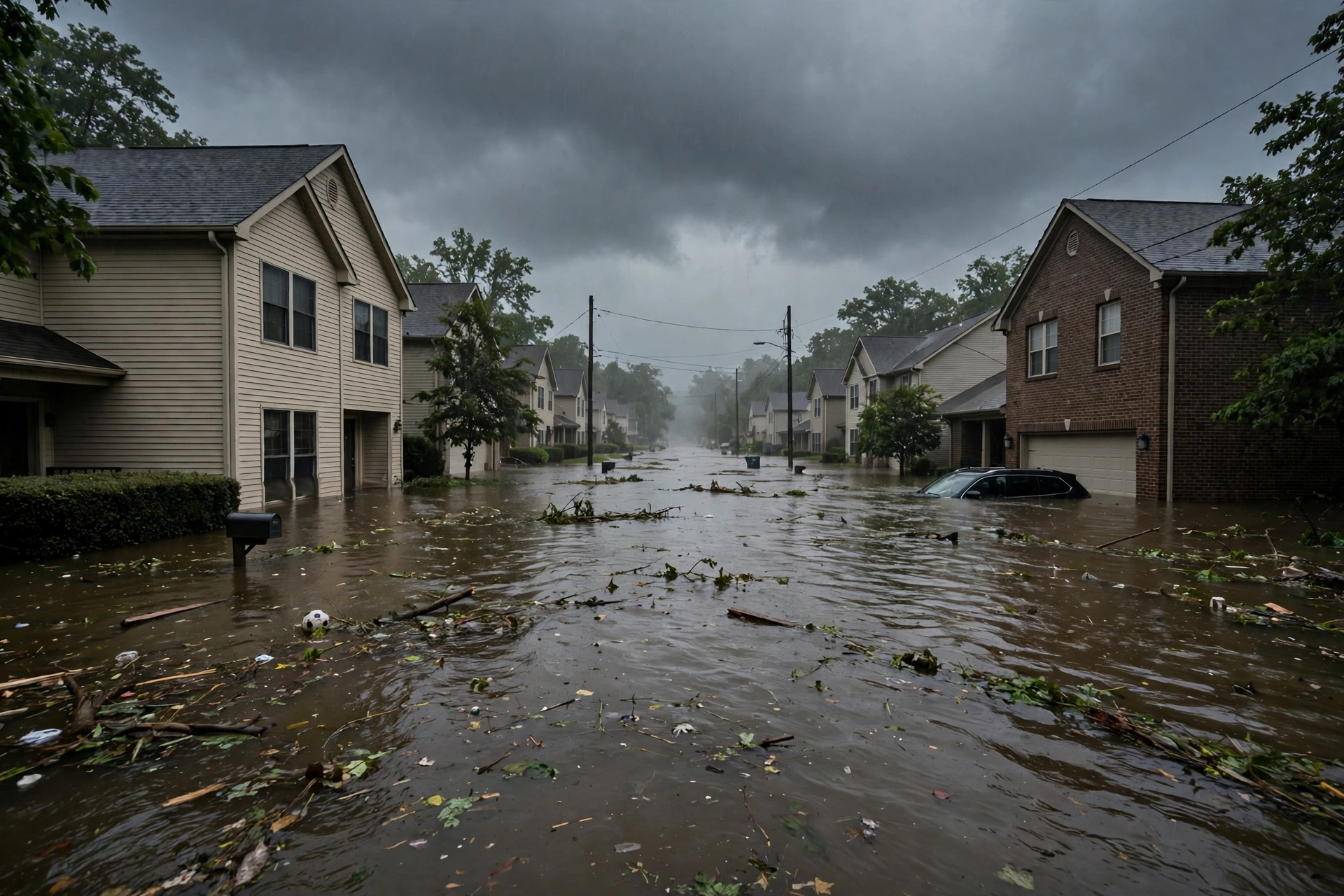
No, homeowners insurance does not cover flood damage. A standard homeowners policy excludes flooding in every state, and the exclusion applies whether you live in a high-risk flood zone or on a hill that has never flooded. Flood coverage is a separate policy, bought through the National Flood Insurance Program (NFIP), which is run by FEMA, or through a private flood insurer.
The distinction matters because flooding is the most common and most expensive natural disaster in the United States, and it is the one most homeowners assume they are covered for. The moment to discover the gap is before the water arrives, because a new flood policy usually takes 30 days to take effect, and you cannot buy coverage as a storm approaches and expect it to apply to that storm.
What counts as a flood
The NFIP defines a flood as a general and temporary condition of partial or complete inundation of two or more acres of normally dry land, or of two or more properties, from sources such as the overflow of inland or tidal waters, or the unusual and rapid accumulation or runoff of surface waters from any source 1. In plain terms, a flood is an excess of water on land that is normally dry, affecting two or more acres or two or more properties.
The two-property and two-acre test is what separates a flood from a household water problem. A burst pipe that floods your kitchen is water damage, and your homeowners policy usually covers it. A river that overflows and floods your street is a flood, and only a flood policy covers it. Rain that pools on the ground and enters the house, a storm surge, a levee failure, and a mudflow all count as flooding under the NFIP definition.
Sewer backup is the edge case that confuses people most. A sewer or drain backup is generally not covered by flood insurance unless the backup was caused by flooding. Homeowners policies also exclude sewer backup by default, though a water backup endorsement can add it. If your basement is at risk from both, you may need both the endorsement and a flood policy.
Why homeowners insurance excludes floods
Homeowners insurance excludes flood for the same reason it excludes earthquakes: the risk is concentrated, catastrophic, and hard to price into a standard policy. A single flood can damage every home in a neighborhood at once, which breaks the pooling logic that lets insurers spread the cost of scattered fires and thefts across many policyholders.
That is why the federal government created the NFIP in 1968. The program sells flood insurance in communities that adopt floodplain management rules, and it is available through private insurers that write policies on FEMA's behalf, as well as directly. Private flood insurance has grown in recent years and now competes with the NFIP, especially for higher-value homes.
The exclusion is not a quirk of one insurer. The standard ISO homeowners form excludes flood, and the exclusion appears in the same list as earth movement, war, and nuclear hazard. If your policy is a standard HO-3, the flood exclusion is in it. Our guide to what homeowners insurance covers lists the full set of exclusions.
What the NFIP covers, and its limits
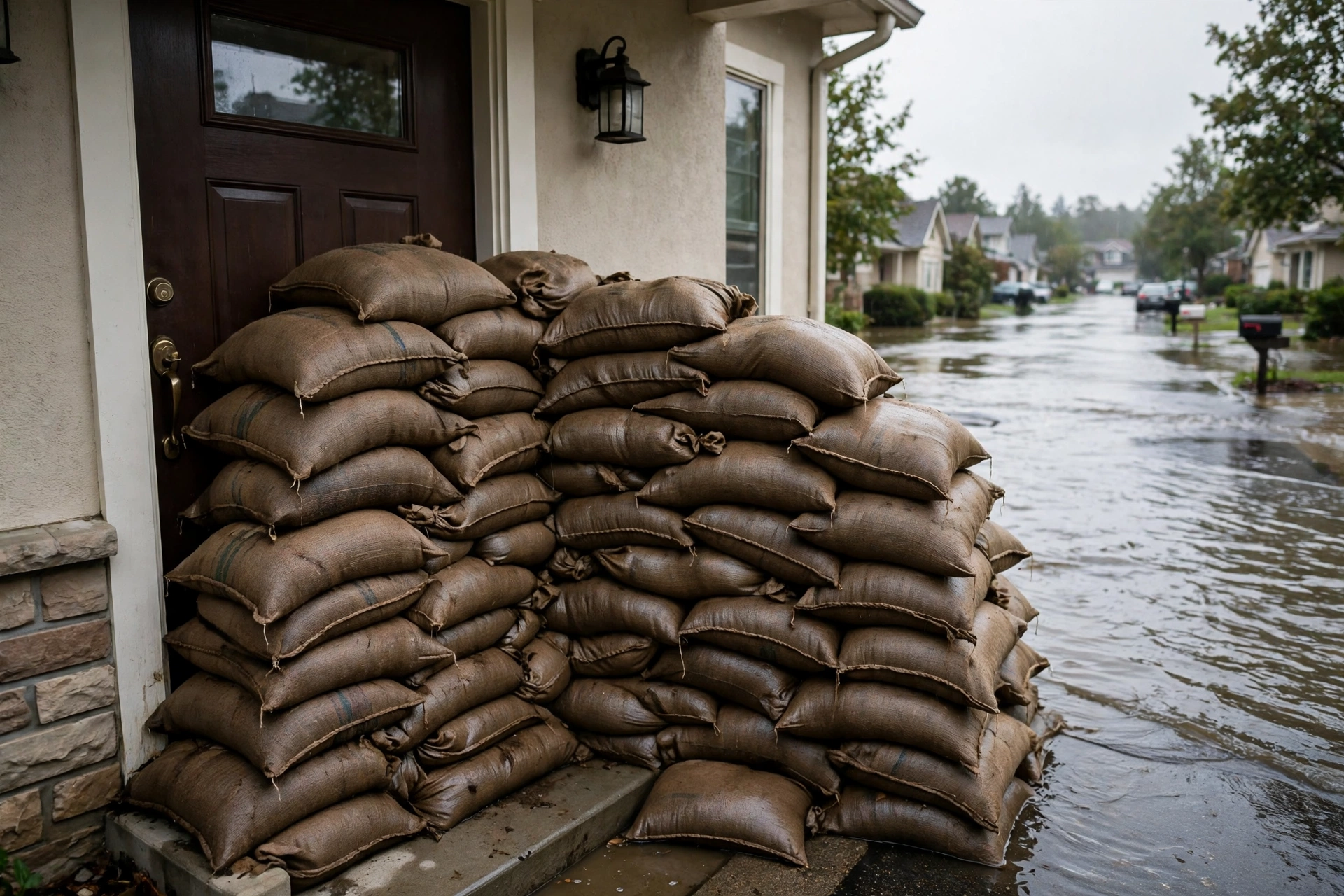
An NFIP policy is split into two parts, bought separately: building coverage and contents coverage. Each has its own limit and its own deductible, and buying building coverage alone, which is what a lender's requirement often amounts to, leaves your belongings uncovered.
For a one-to-four-family residential building, the NFIP maximum is $250,000 for the building and $100,000 for contents 2. Non-residential properties can be insured up to $500,000 for the building and $500,000 for contents. The residential limits are set by federal law and have not changed in decades, which means a home worth more than $250,000 cannot be fully insured through the NFIP alone, and the gap has to be closed with a private flood policy or an excess policy.
Building coverage pays for direct physical damage to the structure and its systems: the foundation, electrical and plumbing systems, furnaces and water heaters, permanently installed cabinetry and carpeting, and a detached garage up to 10% of the building limit. Contents coverage pays for personal property such as clothing, furniture, electronics, and food in freezers. Building coverage for a primary residence can be written on a replacement cost basis if the program's conditions are met, but contents coverage is paid on an actual cash value basis, so depreciation reduces the payout on older items.
| NFIP coverage | Residential maximum | Notes |
|---|---|---|
| Building | $250,000 | Replacement cost if conditions are met |
| Contents | $100,000 | Actual cash value only, bought separately |
| Valuables (art, furs, jewelry) | $2,500 | Special limit inside contents coverage |
| Detached garage | 10% of building limit | Part of building coverage |
What the NFIP does not cover is as important as what it does. It does not pay for additional living expenses, so hotel and rental costs while the home is uninhabitable are yours. It does not pay for loss of use, loss of rental income, or business interruption. It does not cover land, landscaping, decks and patios outside the building, fences, pools, septic systems, or most vehicles. It does not cover currency, precious metals, or valuable papers. And it does not pay for mold or moisture damage that the owner could have prevented by drying the building promptly.
Important
The NFIP does not pay for a place to stay while your home is repaired. If a flood makes your house uninhabitable, hotel and rental costs are on you unless a private flood policy includes additional living expenses. Check that line before you buy, not after a loss.
The 30-day waiting period and its four exceptions
A new NFIP policy does not take effect the day you buy it. The standard waiting period is 30 days, so coverage bought today does not protect against a flood that happens within the next month 1. You cannot buy a policy when a hurricane is forecast and expect it to cover the resulting flood.
There are four exceptions to the 30-day wait:
- No waiting period when the policy is bought in connection with making, increasing, extending, or renewing a mortgage loan, provided you apply on or before the closing date.
- No waiting period when coverage is changed at the time of renewing an existing policy.
- A one-day waiting period when the property is newly designated in a high-risk flood zone and the policy is bought within 12 months of the map update.
- A one-day waiting period when the flood is caused or worsened by a wildfire on federal land, and the policy is bought within 60 days of the wildfire containment date.
The practical rule is simple: buy flood insurance when the sky is clear, not when the forecast turns bad. The 30-day wait is the single most common reason a flood claim is denied, and it is entirely avoidable.
Who is required to buy flood insurance
Federal law requires flood insurance in one specific situation: a building in a Special Flood Hazard Area, the high-risk zone marked A or V on FEMA's flood maps, with a mortgage from a federally regulated lender or backed by Fannie Mae or Freddie Mac. The high-risk zone is the area with a 1% annual chance of flooding, which FEMA describes as at least a one-in-four chance of flooding during a 30-year mortgage 1.
If that applies to you, the lender will require coverage at least equal to the loan balance or the NFIP maximum, whichever is lower, and the lender can buy a policy on your behalf and charge you for it if you let coverage lapse. The requirement lasts as long as the loan does, and it is checked at origination and at renewal.
Outside a high-risk zone, flood insurance is optional, and the lender cannot require it under federal law, though some lenders require it anyway as a condition of the loan. The decision then is yours, and the numbers argue for considering it: FEMA reports that about 29% of NFIP claims over the past 10 years came from outside high-risk flood zones 1. Nearly one-third of claims come from places that were not mapped as high risk, and a standard homeowners policy pays nothing for any of them.
Basement coverage: the fine print that hurts
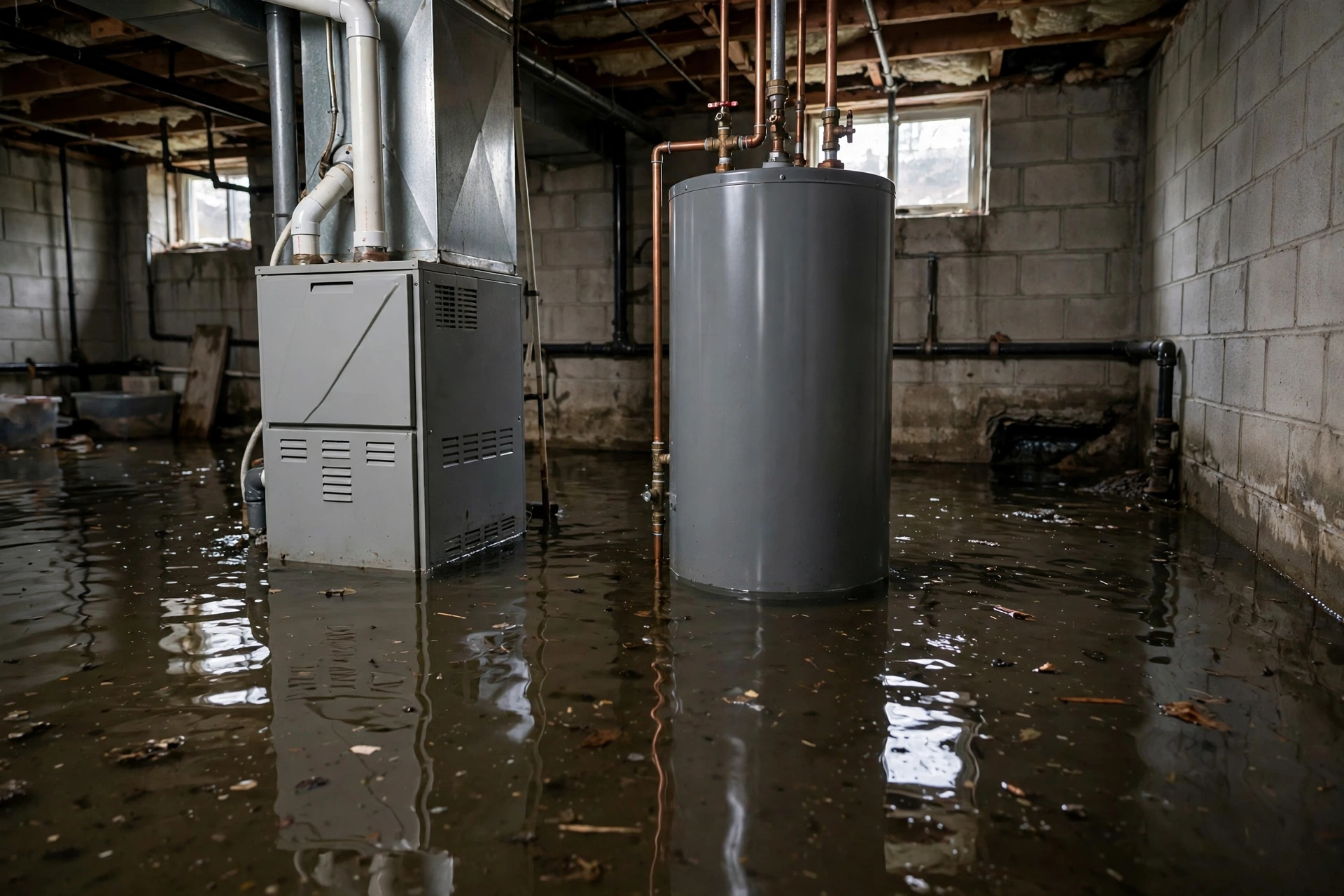
Basement coverage under the NFIP is far more limited than most homeowners expect. The policy defines a basement as any area with its floor below ground level on all sides, including sunken rooms, and coverage below ground is restricted to a specific list 2.
For the building, the covered items are the essentials installed in their functioning locations: furnaces, water heaters, central air conditioning, electrical panels and junction boxes, sump pumps, well pumps and tanks, fuel tanks, elevators, foundation elements, unfinished drywall, stairways attached to the building, and cleanup costs such as pumping out floodwater and drying the structure. Finished walls, floor coverings, bathroom fixtures, and built-in improvements are not covered.
For contents, the only items covered in a basement are those connected to a power source: clothes washers, dryers, portable air conditioners, and food freezers, along with the food inside them. Furniture, electronics, clothing, and boxes stored in the basement get no coverage at all. A finished basement used as a living space is, for insurance purposes, mostly uninsured against flood, and that is a risk to weigh before finishing one in a flood-prone area.
How NFIP claims work
After a flood, report the loss promptly, document the damage with photos and video before cleaning up, and keep receipts for emergency repairs and for items thrown away. The critical deadline is the proof of loss, a signed and sworn statement of the damage and the amount claimed, which must be submitted within 60 days of the flood, unless FEMA grants an extension in writing 2.
The adjuster inspects the property, and the policy says a loss is payable 60 days after the insurer receives the proof of loss and the parties agree on the amount. Keep a copy of everything, and do not sign a proof of loss you disagree with. A lawsuit over a denied NFIP claim must be filed in federal court within one year of the written denial.
How flood insurance is priced: Risk Rating 2.0
Since April 2023, the NFIP has priced policies under a methodology called Risk Rating 2.0, which sets the premium from the property's own risk rather than only from its flood zone. The factors include flood frequency, the distance to water sources, the types of flooding the property faces, the elevation of the structure, and the cost to rebuild 1.
The practical result is that two homes in the same zone can pay very different premiums, and a home outside a high-risk zone can still face a meaningful price if it sits near water or at a low elevation. The program also phases in premium changes over time, so an existing policyholder's rate can rise at renewal even without a claim. Because the price depends on the property, a national average premium is not a useful guide: get a quote for the specific address at FloodSmart.gov or through an agent who writes NFIP policies.
NFIP vs private flood insurance
Private flood insurance has grown as an alternative, and for many homeowners it is worth comparing. The table below summarizes the usual differences, though private policies vary by insurer and state.
| Feature | NFIP | Private flood insurance |
|---|---|---|
| Building limit | $250,000 maximum | Often $500,000 to several million |
| Contents limit | $100,000 maximum | Often $500,000 or more |
| Contents valuation | Actual cash value | Often replacement cost |
| Additional living expenses | Not covered | Often included |
| Waiting period | 30 days, with four exceptions | Typically 10 to 14 days |
| Basement coverage | Limited to a listed set of items | Varies, sometimes broader |
| Lender acceptance | Accepted everywhere | Accepted by most lenders, confirm first |
Private coverage usually costs more for a high-risk property and can cost less for a low-risk one, and it can be the only way to insure a home above the NFIP's $250,000 building cap. Before switching, confirm with the lender that a private policy satisfies the mortgage requirement, and compare the waiting period, the contents valuation, and the living expenses coverage, not just the premium.
What changed in 2026
The NFIP's rules did not change in 2026, but two facts about the program are worth knowing this year. First, Risk Rating 2.0 is now the pricing method for all new and renewing policies, so the premium for a given property reflects its individual risk factors rather than its zone alone 1. Second, the program operates under short-term congressional authorizations, and its authority has been extended in brief increments, which means the availability of new NFIP policies can be interrupted if an authorization lapses. A lapse does not cancel existing policies, but no new policies can be sold until Congress acts, which is one more reason not to wait until a storm is coming.
The weather context is also worth a line. NOAA counted 27 billion-dollar weather and climate disasters in the United States in 2024, the second-highest annual total in its record, and 2024 was the last year that series will cover, because NOAA stopped updating it after calendar year 2024 4. Flood risk is not falling, and the gap between a homeowners policy and a flood policy is the gap a homeowner has to close deliberately.
Frequently asked questions
Does renters insurance cover flood damage? No. A renters policy excludes flood the same way a homeowners policy does. Renters in a flood-prone area need a separate NFIP contents policy, which covers up to $100,000 of the tenant's belongings.
Does homeowners insurance cover a flood caused by a burst pipe? Yes, if the water came from inside the home. A burst pipe is water damage, not a flood, and a standard policy covers sudden and accidental discharge from plumbing. The NFIP definition of flood requires water from outside, affecting two or more acres or two or more properties.
Can I buy flood insurance if my community does not participate in the NFIP? An NFIP policy is available only in participating communities, which are communities that have adopted floodplain management rules. If your community does not participate, private flood insurance is the route, and a local agent can tell you which private carriers write in your area.
How do I find out if my home is in a flood zone? Look up the address in FEMA's Flood Map Service Center, which shows the flood zone, floodplain boundaries, and base flood elevation for the property. An insurance agent can also run the determination, and the lender will run one at closing.
Verified against FEMA FloodSmart.gov and the National Flood Insurance Program on November 15, 2026.
The bottom line
Homeowners insurance does not cover flood damage, and no endorsement on a standard policy fixes that. Flood coverage is a separate policy, through the NFIP or a private insurer, with residential limits of $250,000 for the building and $100,000 for contents under the NFIP 2, a 30-day waiting period with four exceptions, and no coverage for living expenses or finished basements. It is required for a mortgaged home in a high-risk zone, and it is worth considering everywhere else, because about 29% of NFIP claims over the past 10 years came from outside high-risk zones 1. Buy it on a clear day, check the basement limits and the living expenses line, and do not wait for a forecast to decide.
Frequently asked questions
- Does homeowners insurance cover flood damage?
- No. A standard homeowners policy excludes damage from flooding, which is rising water from outside the home. Flood coverage is a separate policy, usually through the National Flood Insurance Program (NFIP) or a private flood insurer.
- What is the difference between flood damage and water damage?
- Water damage from inside the home, such as a burst pipe, is usually covered by homeowners insurance. Flood damage is water from outside, such as a river overflowing, a storm surge, or heavy rain pooling on the ground, and it needs a flood policy.
- How long is the waiting period for flood insurance?
- A new NFIP policy usually takes effect 30 days after purchase. There is no wait when the policy is bought in connection with a mortgage, no wait for changes at renewal, and a one-day wait for a newly mapped high-risk zone or for flooding worsened by a wildfire on federal land.
- How much does flood insurance cost through the NFIP?
- NFIP premiums are set under Risk Rating 2.0, which prices each property on its own flood risk, including flood frequency, distance to water, elevation, and rebuilding cost. Get a quote at FloodSmart.gov or through an agent, because the price varies too much by property for a national average to be useful.
- Do I need flood insurance if I am not in a high-risk zone?
- It is not required, but it is often worth considering. FEMA reports that about 29% of NFIP claims over the past 10 years came from outside high-risk flood zones, and a standard homeowners policy pays nothing for flood damage in any zone.
- Does flood insurance cover basements?
- Only in a limited way. In a basement, the NFIP covers essential building items such as the furnace, water heater, electrical panel, and sump pump, and a short list of contents such as a washer, dryer, and food freezer. Finished walls, flooring, and most stored belongings are not covered.
Sources
Numbers in the text point to these publications. Links open the original source.
- Federal Emergency Management Agency (FEMA). Flood insurance (FloodSmart.gov)
- Federal Emergency Management Agency (FEMA). NFIP flood insurance coverage limits
- Insurance Information Institute (Triple-I). What is covered by standard homeowners insurance?
- National Oceanic and Atmospheric Administration (NOAA). Billion Dollar Weather and Climate Disasters
Related guides
- What Does Homeowners Insurance Cover? (And What It Does Not Cover)
A standard homeowners policy covers your dwelling, other structures, belongings, living expenses, and liability — but not floods or earthquakes.
- What Is Homeowners Insurance and How Does It Work?
Homeowners insurance is a contract that pays to repair or rebuild your home after a covered loss and protects you if someone is hurt on your property.
- How Much Homeowners Insurance Do I Need? Dwelling, Liability and the 80% Rule
Start with the full cost to rebuild your home, not its market value, and keep dwelling coverage at or above 80% of that cost.
This guide is general educational information, not insurance, legal or financial advice. Insurance rules and prices vary by state, company and personal circumstances. Confirm anything important with your state insurance department or a licensed professional. Read the full disclaimer.