Home Insurance, coverage types
Does Homeowners Insurance Cover Water Damage? The Sudden-vs-Gradual Rule
A burst pipe is usually covered. A leak that dripped for months usually is not. A flood is never covered by a standard policy. This guide explains the sudden-vs-gradual test your insurer actually uses, the gaps for sewer backup and mold, and what to do in the first hours after you find water.
- By
- Ella H.
- Published
- Updated
- Reading time
- 14 min read
Key takeaways
- Sudden and accidental water damage — a burst pipe, a failed appliance hose — is usually covered; gradual damage from a slow leak over weeks or months is usually excluded.
- Your policy pays for the damage the water caused, not for the pipe or appliance that failed.
- Flood is excluded from every standard homeowners policy; it needs a separate NFIP or private flood policy, which has a 30-day waiting period.
- Sewer and drain backup is covered by neither a standard policy nor flood insurance — it needs an endorsement, typically with $5,000 to $25,000 of coverage.
- After water damage, contact your insurer promptly, stop further damage, photograph everything, and do not throw damaged items away before the adjuster sees them.
In this guide
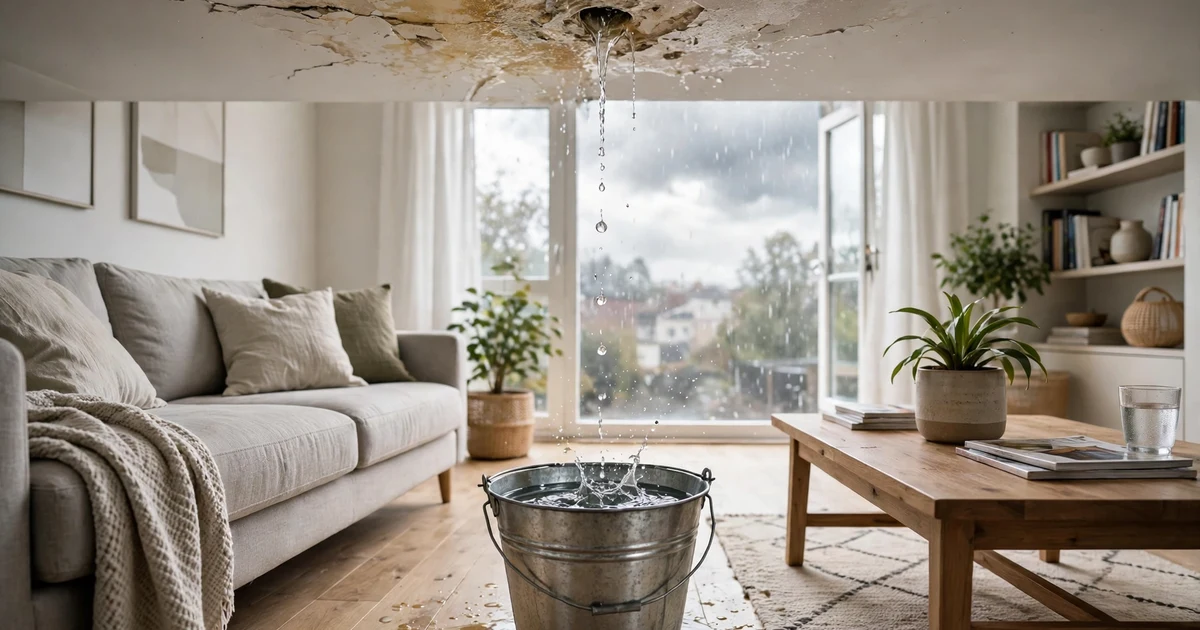
Water is the most common expensive surprise in a house. Not fire, not theft — water. A pipe bursts at 2 a.m., a washing machine hose gives way while you are at work, a slow leak rots a wall for a year before anyone notices. And when homeowners call their insurer, the answer is never a simple yes or no. It depends on how the water got in, how fast it happened, and what kind of water it was.
The numbers show how common this is. Between 2020 and 2024, water damage and freezing caused 1.42 claims per 100 house-years, with an average severity of $17,240 per claim — meaning about 1 in 70 insured homes has a water damage or freezing claim each year 2. Water damage and freezing made up 22.2% of all homeowners insurance losses in 2024 2. Across all causes, 5.1% of insured homes had a claim of some kind in 2024, with an average severity of $21,729 2. Water is not a rare disaster. It is an ordinary risk, and the difference between a covered claim and a denied one usually comes down to a single test your insurer applies to every water claim.
This guide explains that test, what is covered and what is not, the three gaps that surprise people most — flood, sewer backup, and mold — and what to do in the first hours after you find water.
The sudden-vs-gradual test: the rule that decides most claims

Every water damage claim runs through one question: did this happen suddenly, or did it build up over time? The standard homeowners policy — the HO-3 form that most houses carry — covers "accidental discharge or overflow of water or steam" from plumbing, heating, air conditioning, sprinkler systems, and household appliances. A pipe that bursts, a water heater that ruptures, a dishwasher hose that splits open: all sudden, all accidental, all normally covered.
Gradual damage is the opposite, and it is excluded. The policy wording excludes loss caused by "continuous or repeated seepage or leakage of water or steam over a period of weeks, months or years." A pipe joint that dripped slowly behind a wall for six months, a shower seal that let water seep into the floor a little at a time, a roof flashing leak that stained the ceiling a bit more each rain — these are gradual, and the insurer will not pay. The logic is that gradual damage is maintenance: a homeowner who checks the house should have caught it. Whether that is fair in your case is a different question, and it is the most common dispute in water claims — but the rule itself is written into the policy.
The test is about the damage, not the discovery. A leak can run hidden for months and be discovered in a single afternoon, and the insurer will still call it gradual if the damage built up slowly. The adjuster looks for signs of time: staining, rot, mold, rust, warped wood. Fresh water on a dry floor points to sudden. A soft, dark, rotted patch points to gradual. If you find water, photograph it immediately — the photos are evidence of what it looked like when you found it, and they are much harder to argue with than a description written a week later.
There is a second distinction inside the sudden category, and it surprises people just as much: your policy pays for the damage the water caused, not for the thing that failed. The HO-3 wording is direct — the policy does not cover loss to the system or appliance from which the water escaped. If a pipe bursts, the insurer pays to repair the wall, the floor, and the ruined furniture, but not to replace the burst pipe itself. If a water heater fails, the insurer pays for the flooded room, not for the new water heater. The failed part is yours. The damage it caused is the insurer's. Keep that distinction in mind when you read the estimate: the plumber's bill for the new pipe is usually on you, and the contractor's bill for the dried-out wall is usually on the policy.
What is covered: the sudden list
The covered cases follow from the rule above. Each of these is a sudden, accidental release of water inside the home:
- A burst pipe. The classic case. The water damage to walls, floors, ceilings, and belongings is covered; the pipe itself is not.
- A failed appliance. A washing machine hose that breaks, a dishwasher that overflows, a refrigerator ice-maker line that splits, a water heater that ruptures. The water damage is covered; the appliance is not.
- A burst sprinkler or heating pipe. Water from a fire sprinkler system or a heating system that discharges accidentally is covered under the same wording.
- Water from above. Rain that comes in through a hole in the roof or a broken window caused by a covered disaster — a storm that damages the roof, for example — is generally covered 7. The rule of thumb that insurers use is that water from the top down is covered, while water from the bottom up is not.
- A frozen pipe that bursts. Covered, with a condition: the policy covers it if you kept the heat on in the house, or if you shut the water off and drained the pipes. A pipe that froze because you turned the heat off and left the water running is a different story, and a vacant or unheated house is one of the most common disputes in this area — see the section on empty homes below.
The pattern is consistent: the water came from inside the house's own systems, suddenly, and by accident. If your claim fits that pattern, it is likely covered. If the water came from outside the house, or from a drain backing up, or from a leak that ran for months, it likely is not — and those are the next three sections.
What is not covered: flood, sewer backup, and slow leaks
Three exclusions account for most denied water claims, and each has its own fix.
Flood is excluded from every standard homeowners policy. A standard homeowners or renters policy does not pay for flood, earthquake, or routine wear and tear 1. Flood means water rising from outside — a river overflowing, heavy rain pooling around the house, a storm surge. It does not matter how sudden the flood was; the exclusion is absolute. Flood needs a separate policy, either from the National Flood Insurance Program (NFIP) or from a private flood insurer 6 3. An NFIP policy covers up to $250,000 for the building and $100,000 for contents 5, and it has a 30-day waiting period before coverage takes effect 3. That waiting period is the trap: you cannot buy flood insurance when the storm is on the news. You must buy it a month before you need it, which in practice means buying it before hurricane season, not during it.
Sewer and drain backup is covered by neither a standard policy nor flood insurance. When a sewer line backs up into a basement, or a drain overflows into a bathroom, the standard homeowners policy does not pay — and a flood policy does not pay either, because backup is not flood. The National Association of Insurance Commissioners notes that most homeowners policies offer limited or no coverage for sewer and drain backups and sump pump overflow, and that endorsements may be available 8. The fix is an endorsement, often called water backup coverage, added to your homeowners policy. Endorsements typically offer $5,000 to $25,000 of coverage and often cost $50 to $150 a year, though the price varies by carrier and state. No single price exists, and any source quoting one exact figure is guessing. The coverage is cheap compared with the cost of a flooded basement, and it is the single most commonly missing endorsement in American homeowners insurance. If your house has a basement, or a bathroom below street level, ask your insurer about it before the next heavy rain.
Gradual damage is excluded, as above. The slow leak behind the wall, the seepage under the shower, the drip from a pipe joint that nobody saw for a year. The policy calls it continuous or repeated seepage over weeks, months, or years, and it does not pay. There is no endorsement that fixes this one. The only defense is maintenance: check under sinks, look at ceilings after heavy rain, fix small leaks when they are small. A $15 washer replaced in time is cheaper than a $17,240 claim that gets denied.
A note on older numbers you may see elsewhere: some guides still quote an average water claim of $15,400 and say 1 in 50 or 1 in 60 homes has a claim each year. Those are the 2019–2023 figures. The current Insurance Information Institute page reports 2020–2024 data: $17,240 average severity, 1.42 claims per 100 house-years, about 1 in 70 homes a year 2. Use the current figures. The older ones are not wrong for their time, but they are not the numbers today.
Mold: covered only when the water was covered
Mold follows the water. If a burst pipe soaks a wall and mold grows in the damp drywall, the mold is part of the same covered claim — because the water event that caused it was sudden and covered. If mold grows from a slow leak, from neglect, or from a flood, it is not covered, because the water event behind it was not covered. The rule is simple: mold is covered only when it results from a sudden, covered peril.
Even then, the coverage is often capped. Many policies carry a mold sublimit — a separate, lower ceiling just for mold — commonly $1,000 to $10,000, with $5,000 a frequent default. Some insurers cap it lower still. The range varies by carrier and by state, and the exact number is on your declarations page, not in any national table. Check it before you need it, because a $10,000 mold cap against a $30,000 remediation bill leaves a large gap — and mold remediation costs themselves are contractor estimates that vary widely, so this guide gives no single figure for them.
Time matters with mold in a practical way, not just a legal one. Damp materials should be dried within 24 to 48 hours to prevent mold growth, according to guidance from the Environmental Protection Agency that is widely cited by insurers and restoration companies. That window is why the "what to do" section below starts with stopping the water and drying the area: every hour of standing water is an hour of mold growth, and mold that grows because the water sat for a week is harder to claim than mold that grew despite a fast response.
Frozen pipes and empty homes
Frozen pipes deserve their own section because they are the most expensive winter claim and the most avoidable. A pipe freezes, bursts, and releases water into the house — often while nobody is home to notice. The average water claim is $17,240, but a burst-pipe claim in a house that sat empty for days can run far higher, because the water runs until someone finds it 2.
The coverage rule is the same sudden test, with one condition attached: the policy covers a frozen pipe if you kept the heat on, or shut the water off and drained the pipes. Leave the heat on when you travel in winter — even at a low setting — and if you are leaving for a long stretch, shut the water off at the main and drain the pipes. Those two steps are the difference between a covered claim and a fight.
The empty-house problem goes further. Most homeowners policies carry a vacancy clause: if the house sits unoccupied for a set period — typically 30 to 60 days — coverage narrows or stops, and the insurer may deny a claim for damage that happened while the house was empty 4. The exact period is in your policy, and it varies. If you are leaving a house empty for more than a month — a winter in another state, a home for sale, an inherited house being settled — tell your insurer before you go. A vacancy endorsement or a vacant-home policy costs money, but it costs less than a burst-pipe claim that gets denied because the house was empty when the pipe froze.
What to do after water damage

The first hours after you find water matter more than the first days. What you do now decides what the adjuster can verify later. The steps below follow the Insurance Information Institute's guidance for settling claims after a disaster 7.
Contact your insurer promptly. Call the claims number as soon as you find the damage. Do not wait until you have cleaned up, and do not wait until Monday if you found it on a Saturday. A prompt report is part of your duty under the policy, and a late report is one of the easiest reasons for an insurer to question a claim. When you call, ask for the claim number, write down the name of the person you spoke to, and ask what the insurer wants you to do next.
Stop further damage. This is your duty as the homeowner, and it is called mitigation. Shut off the water at the main if the source is a pipe or appliance. Move dry belongings out of the wet area. Mop up standing water if you can do so safely. Put a tarp over a hole in the roof. Do not wait for the adjuster to arrive before you stop the water — every hour of running water is more damage, and the insurer can refuse to pay for damage that you could have prevented. Keep every receipt for emergency spending: tarps, fans, a plumber's emergency call, a hotel room if the house is unlivable. Those costs are part of the claim.
Document everything before you clean up. Photograph the water, the damaged rooms, the damaged belongings, and the source of the leak, from several angles, before you move anything. Then make an inventory: a list of what was damaged, with the brand, the age, and the price if you know it. Only 47% of homeowners have an inventory of their belongings 2 — and the ones who do settle their claims faster, because the adjuster does not have to guess what was in the room. If you do not have an inventory, start one now, while the damage is in front of you. A phone video walkthrough of each wet room takes two minutes and is better than no record at all.
Do not throw damaged items away before the adjuster sees them. This is the mistake people make most often, because the instinct after a flood is to clear the mess. The adjuster needs to see the damage to value it. Bag wet items, move them to a dry place if you must, but keep them until the adjuster has inspected them. If something is a health hazard — soaked drywall, contaminated carpet after a sewer backup — photograph it thoroughly first, then discard it, and tell the adjuster you did so and why.
Know about additional living expenses. If a covered disaster makes your home unlivable, your policy's additional living expenses (ALE) coverage pays for the extra cost of living elsewhere — a hotel, meals out, laundry — while the home is repaired 7. ALE has its own limit, usually a percentage of the dwelling coverage or a fixed dollar amount, and it applies only when the damage is from a covered event. A flood that is not covered does not trigger ALE. A burst pipe that is covered does. Ask your adjuster whether ALE applies and what its limit is before you book a long hotel stay.
File the claim, then follow it. The insurer will send an adjuster, who inspects the damage, reviews your photos and inventory, and writes an estimate. You can hire your own contractor for a second estimate if the insurer's number looks low. Keep copies of everything — the claim number, the adjuster's report, every estimate, every receipt — in one folder. If the claim is denied, ask for the denial in writing, with the policy language it relies on. Most disputes turn on one sentence in the policy: sudden or gradual, covered or excluded, and the written denial tells you exactly which sentence the insurer is standing on.
Verified against the Insurance Information Institute and the Federal Emergency Management Agency on November 18, 2026.
The bottom line
Homeowners insurance covers sudden and accidental water damage — a burst pipe, a failed appliance hose, a water heater that ruptures — but it pays for the damage the water caused, not for the pipe or appliance that failed. It does not cover gradual damage from a leak that seeped for weeks or months, and it never covers flood, which needs a separate NFIP or private flood policy with a 30-day waiting period. Sewer backup needs its own endorsement, typically $5,000 to $25,000 of coverage, because neither a standard policy nor flood insurance pays for it. Mold is covered only when it grows from a sudden, covered event, and even then it is often capped at $1,000 to $10,000. Water damage and freezing now average $17,240 a claim, hitting about 1 in 70 homes a year. When you find water, act fast: call your insurer, stop the water, photograph everything, keep your receipts, and do not throw anything away until the adjuster has seen it.
Frequently asked questions
- Does homeowners insurance cover water damage?
- It covers sudden and accidental water damage — for example, a pipe that bursts, a water heater that fails, or a washing machine hose that breaks. It does not cover gradual damage from a leak that dripped for weeks or months, and it does not cover flood. The test is whether the damage happened suddenly or built up slowly.
- Does homeowners insurance cover a burst pipe?
- Usually, yes — the water damage the burst pipe caused to your walls, floors, and belongings is covered. But the pipe itself is not: your policy pays for the damage, not for the failed part. Frozen pipes are covered if you kept the heat on, or shut the water off and drained the pipes.
- Does homeowners insurance cover flood damage?
- No. Flood is excluded from standard homeowners and renters policies. You need a separate flood policy, either from the National Flood Insurance Program (NFIP) or a private insurer. An NFIP policy covers up to $250,000 for the building and $100,000 for contents, and it has a 30-day waiting period before coverage starts.
- Does homeowners insurance cover sewer backup?
- No — not under a standard policy, and not under flood insurance either. Sewer and drain backup needs a separate endorsement or policy. Endorsements typically offer $5,000 to $25,000 of coverage and often cost $50 to $150 a year, though the price varies by carrier and state.
- Does homeowners insurance cover mold?
- Only when the mold results from a sudden, covered event — for example, mold that grows after a burst pipe. Mold from a slow leak, from neglect, or from a flood is not covered. Even when mold is covered, it is often capped at a sublimit, commonly $1,000 to $10,000, so check your declarations page.
- What should I do first after finding water damage?
- Contact your insurer promptly, stop further damage if you can do so safely — shut off the water, move belongings out of the way — and document everything with photos and an inventory before you clean up. Keep receipts for any emergency spending, and do not throw damaged items away until the adjuster has seen them.
Sources
Numbers in the text point to these publications. Links open the original source.
- Insurance Information Institute (Triple-I). What is covered by standard homeowners insurance?
- Insurance Information Institute (Triple-I). Facts + Statistics: Homeowners and renters insurance
- Insurance Information Institute (Triple-I). Facts about flood insurance
- Insurance Information Institute (Triple-I). When No One's Home: Understanding Role of Vacancy Insurance
- Federal Emergency Management Agency (FEMA). NFIP flood insurance coverage limits
- Federal Emergency Management Agency (FEMA). Flood insurance (FloodSmart.gov)
- Insurance Information Institute (Triple-I). Settling insurance claims after a disaster
- National Association of Insurance Commissioners (NAIC). Dwelling Fire, Homeowners Owner-Occupied, and Homeowners Tenant and Condominium/Cooperative Unit Owner's Insurance Report
Related guides
- What Does Homeowners Insurance Cover? (And What It Does Not Cover)
A standard homeowners policy covers your dwelling, other structures, belongings, living expenses, and liability — but not floods or earthquakes.
- Does Homeowners Insurance Cover Flood Damage? NFIP, Costs and the 30-Day Wait
No, a standard homeowners policy excludes flood damage. Flood coverage comes from a separate NFIP or private policy, with a 30-day waiting period.
- How to File a Homeowners Insurance Claim: A Step-by-Step Guide
Damage happened. Here is what to do first, how the adjuster and the two-check payment work, your state's deadlines, and what to do if the claim is denied.
This guide is general educational information, not insurance, legal or financial advice. Insurance rules and prices vary by state, company and personal circumstances. Confirm anything important with your state insurance department or a licensed professional. Read the full disclaimer.