Home Insurance, basics
How to File a Homeowners Insurance Claim: A Step-by-Step Guide
You just had damage to your home. This guide walks you through what to do in the first hours, how to document the loss, what the adjuster does, how your payment is worked out, and the deadlines your insurer has to meet — plus what to do if the offer is too low.
- By
- Ella H.
- Published
- Updated
- Reading time
- 12 min read
Key takeaways
- Call your insurer right away, make only temporary repairs, and do not throw anything away or start permanent repairs before the adjuster visits.
- Your payment depends on whether your policy pays replacement cost or actual cash value — on the same $15,000 roof, the difference can be $14,000 versus $4,000.
- Most insurers pay in two checks: the first is an advance, and the second is the withheld depreciation, paid after repairs are finished.
- There is no single national deadline. Texas, Florida, and California each set their own clocks for the insurer to acknowledge, decide, and pay.
- If the offer is too low, work the ladder in order: written denial, re-inspection, internal appeal, appraisal, a free complaint to your state insurance department, and only then a public adjuster or a lawyer.
In this guide
- The claim in six steps
- Should you file a claim at all?
- What to do right after the damage
- How to report the claim
- Documenting the damage
- The adjuster visit: what to expect
- The proof-of-loss form
- How your payment is worked out
- How long does a claim take? Deadlines by state
- What to do if your claim is denied or too low
- Mistakes that can hurt your claim
- The bottom line
- Frequently asked questions
- Sources
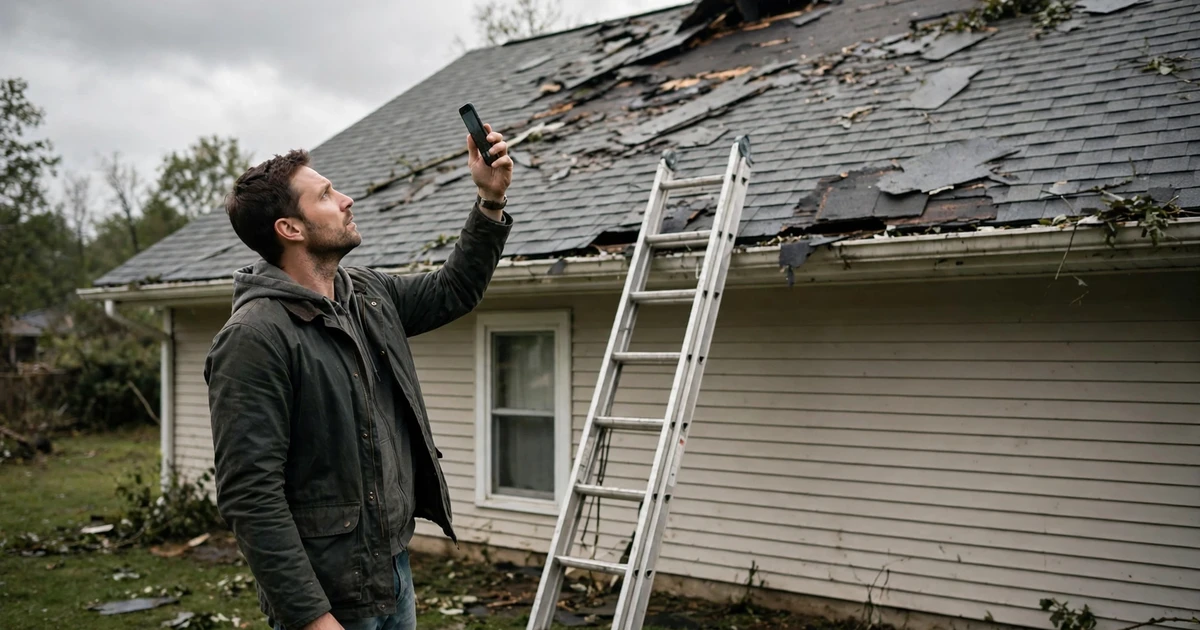
Damage just happened to your home. This guide takes you through the claim step by step.
In 2023, 5.3% of insured homes had a claim — about 1 in 18 — and property damage, including theft, was 97.3% of homeowners claims 2. Wind and hail caused 42.5% of losses, water damage 22.6%, and fire and lightning 21.6%; the average claim over 2019–2023 was $17,059 2.
The claim in six steps
The claim in six steps: make it safe; call your insurer; document everything; meet the adjuster; get paid in two checks; and push back if the offer is too low. Two rules throughout: do not throw damaged items away until the adjuster has seen them, and do not start permanent repairs until the adjuster has approved the price 1.
Should you file a claim at all?
Before you call, compare the damage with your deductible — the amount you pay yourself before the insurer pays anything. If repairs cost $2,500 and your deductible is $2,000, the insurer pays $500. Filing for $500 may not be worth it, because a claim can affect your premium at renewal.
Ask three questions. Is the damage more than the deductible by a real margin? If the repair bill is barely above your deductible, paying out of pocket is often simpler. Is the damage covered at all? Wear and tear is not covered: a 25-year-old roof that leaks is a maintenance problem, not a claim, while a roof that leaks because a storm tore off shingles is a claim. If you are unsure, check our guide on what homeowners insurance covers. Is it flood damage? Flood is excluded from a standard homeowners policy. Flood is excluded from a standard policy; flood cover is a separate policy, usually from the NFIP, which provides up to $250,000 for the structure and $100,000 for personal possessions 1.
If the answer to all three is yes, file. If the damage is small or clearly wear and tear, think twice.
What to do right after the damage
Safety first. If the home is unsafe — a gas smell, sparking wires, a collapsed ceiling — leave and call emergency services.
Stop further damage. Take reasonable steps to protect the property: a tarp over a hole in the roof, boards over a broken window, shutting off the water main after a burst pipe. Save every receipt — payments for temporary repairs are part of the total settlement. Do not make extensive permanent repairs yet; the adjuster has to see the damage first 1.
Call the police for theft or vandalism — a police report supports the claim, and the insurer will usually ask for one.
Photograph and video everything before you move or clean anything — walk every damaged room slowly and take close-ups; photos taken after the cleanup are worth far less.
If you cannot stay in the home, keep receipts. Policies cover additional living expenses when a covered disaster makes the home unlivable — hotel, meals out, extra transport — generally equal to 20 percent of the insurance on the home, in addition to the repair money 1.
How to report the claim
Contact your agent or insurer immediately — by phone, app, or online. Before you call, have your policy number, the date of the loss, a short description, and your photos ready.
On the call, ask these five questions 1: Is the damage covered under my policy? How long do I have to file a claim? Does my claim exceed my deductible? How long will it take to process the claim? Will I need estimates for repairs?
Get a claim number, and write down the name and phone number of everyone you speak to. Keep copies of everything you send and receive 1.
Documenting the damage

Only 47% of homeowners said they had prepared an inventory of their possessions, according to a 2023 survey 2 — and the adjuster can only pay for what you can show them.
Write an inventory of damaged or destroyed items. For each item, note a description, the approximate date you bought it, and what it would cost to replace or repair — attach receipts if you have them 1. Give a copy to the adjuster and keep one.
Photograph the structure, not just the contents. List everything you want to show the adjuster: cracks in the walls, missing roof tiles, a damaged garage or shed.
Get written bids from licensed contractors, line by line — that detail makes adjusting the claim faster 1.
Save every receipt — temporary repairs, hotel nights, meals, tarps, fans, storage.
The adjuster visit: what to expect

The adjuster is professionally trained to assess damage. Your insurer provides one at no charge — this is your insurer's adjuster, not yours 1.
Walk the damage with them. Do not hand over the keys and leave. Walk every room together and show them the contents inventory — the more you can tell them, the faster the claim is generally settled 1.
Have your contractor there if you can. A contractor who knows the repair can point out damage the adjuster might miss. Show the adjuster your written bids — if the adjuster agrees with one, repairs can begin 1.
Do not throw anything away until the adjuster has visited — damaged items are evidence. If something is a health hazard, photograph it thoroughly first.
Do not sign anything you do not understand, including settlement releases and any form that assigns your claim benefits to a contractor. Ask for a copy of the adjuster's estimate.
If your car was damaged too, that is a separate claim: with comprehensive cover on your auto policy, contact your auto insurer, not your homeowners insurer 1.
The proof-of-loss form
Some insurers will ask you to fill out and sign a proof-of-loss form — a formal statement of your losses and the amount you are claiming 1; some waive it after a disaster if you met the adjuster and the claim is simple.
Your policy sets the deadline for this form — check it and meet it; there is no single universal number of days. Fill it in fully, list every item from your inventory, attach your receipts and contractor bids, and keep a copy.
How your payment is worked out
Your payment depends on your deductible and on whether your policy pays replacement cost or actual cash value.
Replacement cost (RCV) pays what it costs to replace a damaged item with one of similar kind and quality, without deducting for depreciation — the loss of value from age and wear 1. Actual cash value (ACV) pays that cost minus depreciation 1. A tree falls on an eight-year-old washing machine: replacement cost buys a new one; actual cash value pays only part of a new one 1.
The NAIC gives a worked example with a roof 3: two families, the same $15,000 roof damage, the same $1,000 deductible.
| Replacement cost | Actual cash value | |
|---|---|---|
| Roof damage | $15,000 | $15,000 |
| Minus depreciation | $0 | −$10,000 |
| Minus deductible | −$1,000 | −$1,000 |
| Payment | $14,000 | $4,000 |
Same roof, same damage, same deductible — a $10,000 difference, decided by one word in the policy. Some policies also have separate deductibles for wind or hail, and some pay actual cash value on the roof even when the rest of the house is replacement cost 3.
The two-check system. Most companies pay with two checks. The first comes after the adjuster looks at the loss, for the estimated repair cost minus depreciation and your deductible. The second is the withheld depreciation, paid after the insurer gets the contractor's bill for the finished job — in Texas, repairs must be completed within 365 days of the date of loss 5.
The first check is often an advance. You can accept an on-the-spot settlement right away, and if you find more damage later, you can reopen the claim 1. Do not sign a release that says the first check settles everything before you have seen all the damage.
If your home is mortgaged, the repair check is generally made out to you and the mortgage lender, who must endorse it and generally puts the money in an escrow account 1. When both the home and its contents are damaged, you generally get two separate checks — one for the structure, one for the contents 1.
How long does a claim take? Deadlines by state
There is no single national deadline to file a homeowners claim, and no single national timeline for the insurer to pay. Your deadline to report the loss is set by your policy — most say "promptly" — and, in some states, by law; most policies require claims within one year of the disaster, but that is a common policy term, not a law in every state 1. The insurer's deadlines are set by state law, and they differ in length and in when the clock starts.
| Acknowledge your claim | Decide: accept or deny | Pay after agreement | |
|---|---|---|---|
| Texas 5 | Within 15 days of receiving it | Within 15 business days of getting all the information | Within 5 business days after agreeing to pay |
| Florida 6 7 | Within 7 days of your communication | Within 30 days after a complete proof of loss: covered, partly covered, or denied | Within 60 days: full payment, the undisputed part, or a denial |
| California 9 | Within 15 days of notice | Within 40 days after receiving proof of claim | Within 30 days after acceptance or settlement |
In Texas, the insurer must also start its investigation within 15 days, and explain a rejection in writing 5. In Florida, the law changed in 2023: the old rules gave 14 days to acknowledge and 90 days to pay; the current law gives 7 days and 60 days 6; if the insurer misses the 60 days, interest runs from the date the claim was filed 7. In California, if the insurer needs more time, it must explain why in writing and send an update every 30 days 9.
Your deadline to report the loss matters too. In Florida, the outer limit is set by statute: a new or reopened claim within 1 year of the date of loss, and a supplemental claim within 18 months — for a hurricane, the date of loss is the landfall date 8. Texas has no statute setting one deadline; the policy controls.
Simple claims can close in weeks; complex or disputed claims can take months. If your state is not in the table, check your state insurance department's website.
What to do if your claim is denied or too low
Work this ladder in order. Each step costs more time or money than the one before it, so do not skip ahead.
- Ask for the denial in writing. Get the exact policy wording the denial relies on — a verbal "not covered" is not a decision you can fight — and read the policy section yourself: denials sometimes cite the wrong exclusion.
- Ask for a re-inspection or send a supplement. Tell the company why you disagree; it may have missed something. Send your contractor's line-by-line estimate and point to the items the adjuster's estimate left out — and if you find more damage after the first visit, reopen the claim 1.
- Appeal inside the company. Contact your agent or the claim department manager, with figures to back up your claim 1.
- Use appraisal — for the amount only. If you cannot agree on a settlement amount, your policy usually allows an independent appraisal: both sides hire appraisers, who choose a third appraiser as umpire, and the decision of any two of the three is binding. You pay for your appraiser and half the umpire's costs. Appraisal settles the amount, not coverage — it cannot overturn a denial 1. Some companies offer arbitration instead 1.
- File a complaint with your state insurance department — free. Your state department of insurance (DOI) protects policyholders and makes sure insurers follow the rules. Try the insurer first; if you are still not satisfied, contact the DOI 4. The DOI investigates complaints for free, including unfair delays or denials. Gather your policy number, documents, bills, and records; keep a record of all communication; write a detailed account with facts and dates; and state the outcome you want 4. The DOI forwards the complaint to the insurer, which must respond. It cannot order a specific payment, but it can require an insurer that acted improperly to correct the problem — and an insurer cannot punish you later for filing a complaint 4. In Texas, call the TDI Consumer Help Line at 800-252-3439 5; in Florida, the DFS Insurance Consumer Helpline is 1-877-693-5236 6.
- Consider a public adjuster — only for large or complex claims. A public adjuster works for you, not the company, and charges a fee: this service could cost you as much as 15 percent of the total value of your settlement 1. On a small claim that fee can wipe out the gain. Check references with the Better Business Bureau and your state insurance department, and with the National Association of Public Insurance Adjusters 1.
- Use free mediation where your state offers it. In Florida, most disputed residential claims can go to free mediation by the Florida Department of Financial Services, at the insurer's cost 6.
- A lawyer is the last step. If the amount is large and every step above has failed, talk to an attorney who handles insurance claims — and get the fee agreement in writing first.
Mistakes that can hurt your claim
- Throwing damaged items away before the adjuster visits — photograph them first.
- Starting permanent repairs before the adjuster visits — temporary repairs protect the home; permanent repairs destroy the evidence.
- Waiting too long to report — report right away, even if you do not yet know the full extent of the damage.
- Signing a contract or an assignment-of-benefits form without reading it — understand the fee and what you are giving up before you sign 6.
- Not keeping copies — every list, receipt, bid, letter, and phone note goes in one folder.
- Accepting the first check as the final word — it is often an advance; if you find more damage, reopen the claim 1.
Verified against the Insurance Information Institute and the Texas Department of Insurance on November 16, 2026.
The bottom line
A homeowners claim has six steps: stop more damage, call your insurer, document everything, walk the damage with the adjuster, get paid in two checks, and push back if the offer is too low. Your payment turns on one word in your policy — replacement cost or actual cash value: on the same $15,000 roof, $14,000 versus $4,000. There is no national deadline — Texas gives the insurer 15 days to acknowledge and 5 business days to pay, Florida gives 7 days and 60 days, California gives 15 days and 40 days to decide. If the offer is too low, work the ladder in order; a complaint to your state insurance department is free.
Frequently asked questions
- How long do I have to file a homeowners insurance claim?
- There is no single national deadline. Your policy sets the deadline — most policies say to report promptly, and many require a claim within one year of the disaster. Some states set an outer limit by law: in Florida, a new or reopened claim must be reported within 1 year of the date of loss, and a supplemental claim within 18 months. Report as soon as you can.
- How long does a homeowners insurance claim take?
- It depends on the damage and your state. Texas gives the insurer 15 days to acknowledge, 15 business days to decide once it has all the information, and 5 business days to pay after it agrees. Florida gives 7 days to acknowledge and 60 days to pay or deny. California gives 15 days to acknowledge, 40 days to decide after proof of claim, and 30 days to pay after acceptance. Simple claims can close in weeks; complex or disputed claims can take months.
- What is the difference between actual cash value and replacement cost?
- Replacement cost pays what it costs to repair or replace the damaged item, without deducting for age. Actual cash value pays that cost minus depreciation. The NAIC gives a roof example: two families, the same $15,000 roof damage, a $1,000 deductible. The replacement-cost family gets $14,000; the actual-cash-value family gets $4,000, because $10,000 was taken off for depreciation.
- Why did I get two checks — and how do I get the second one?
- On a replacement-cost policy, the insurer usually pays in two checks. The first is the actual cash value — the estimated repair cost minus depreciation and your deductible. The second is the withheld depreciation, paid after the repairs are done and you send the contractor's bill — in Texas, repairs must be completed within 365 days of the date of loss. The first check is often an advance, and if you find more damage later, you can reopen the claim.
- What should I do if my claim is denied or the offer is too low?
- Work the ladder in order: ask for the denial in writing, with the exact policy wording it relies on; ask for a re-inspection or send your own contractor's estimate; appeal to a claim manager inside the company. If the dispute is only about the amount, use appraisal: each side hires an appraiser and they choose an umpire. File a free complaint with your state insurance department. A public adjuster works for you but can cost as much as 15% of the settlement, so consider one only for large or complex claims.
- Do I have to use the contractor my insurer suggests?
- No. The choice of repair firm is yours. Do not start permanent repairs until the adjuster has approved the price — if the adjuster agrees with one of your bids, repairs can begin. Your insurer may recommend firms it has worked with, and some even guarantee their work, but that choice stays with you.
Sources
Numbers in the text point to these publications. Links open the original source.
- Insurance Information Institute (Triple-I). Settling insurance claims after a disaster
- Insurance Information Institute (Triple-I). Facts + Statistics: Homeowners and renters insurance
- National Association of Insurance Commissioners (NAIC). Rebuilding After a Storm: Know the Difference Between Replacement Cost and Actual Cash Value When It Comes to Your Roof
- National Association of Insurance Commissioners (NAIC). How to File a Complaint
- Texas Department of Insurance. How do I file a homeowners insurance claim?
- Florida Department of Financial Services, Division of Consumer Services. Homeowner Claims Bill of Rights
- Florida Senate (Official Florida Statutes). Chapter 627 Section 7142 — Homeowner Claims Bill of Rights (Florida Statutes)
- Florida Senate (Official Florida Statutes). Chapter 627 Section 70132 — Notice of property insurance claim (1 year; 18 months for supplemental claims)
- California Department of Insurance. Residential Property Claims Guide (Fair Claims Settlement Practices Regulations, 10 CCR §§ 2695.5, 2695.7)
Related guides
- What Does Homeowners Insurance Cover? (And What It Does Not Cover)
A standard homeowners policy covers your dwelling, other structures, belongings, living expenses, and liability — but not floods or earthquakes.
- Does Homeowners Insurance Cover Flood Damage? NFIP, Costs and the 30-Day Wait
No, a standard homeowners policy excludes flood damage. Flood coverage comes from a separate NFIP or private policy, with a 30-day waiting period.
- How Much Homeowners Insurance Do I Need? Dwelling, Liability and the 80% Rule
Start with the full cost to rebuild your home, not its market value, and keep dwelling coverage at or above 80% of that cost.
This guide is general educational information, not insurance, legal or financial advice. Insurance rules and prices vary by state, company and personal circumstances. Confirm anything important with your state insurance department or a licensed professional. Read the full disclaimer.