Home Insurance, coverage types
Umbrella Insurance: What It Covers, What It Costs, and How Much You Need
Your auto and home policies cap what they pay when you are sued. An umbrella policy picks up where they stop — but only after you raise their limits first, and that hidden step is what most guides leave out.
- By
- Ella H.
- Published
- Updated
- Reading time
- 16 min read
Key takeaways
- An umbrella policy kicks in when you reach the limit on the underlying liability coverage in your auto, homeowners, renters, or condo policy.
- A $1 million umbrella policy costs about $150 to $300 a year, and each additional $1 million costs roughly $50 to $75 a year, according to the Insurance Information Institute.
- Most insurers want about $250,000 of liability on your auto policy and $300,000 on your homeowners policy before they will sell you an umbrella policy.
- Umbrella policies typically start at $1 million and are available up to $5 million or $10 million from most insurers.
- The true first-year cost is higher than the umbrella premium alone, because raising your underlying limits to the required levels can add hundreds a year to your auto and home premiums.
In this guide
- What an umbrella policy does
- What umbrella insurance costs
- The hidden first step: raise your underlying limits
- How much umbrella insurance do you need
- What it covers — and what it does not
- Who should consider an umbrella policy
- How to buy umbrella insurance: a short checklist
- The bottom line
- Frequently asked questions
- Sources
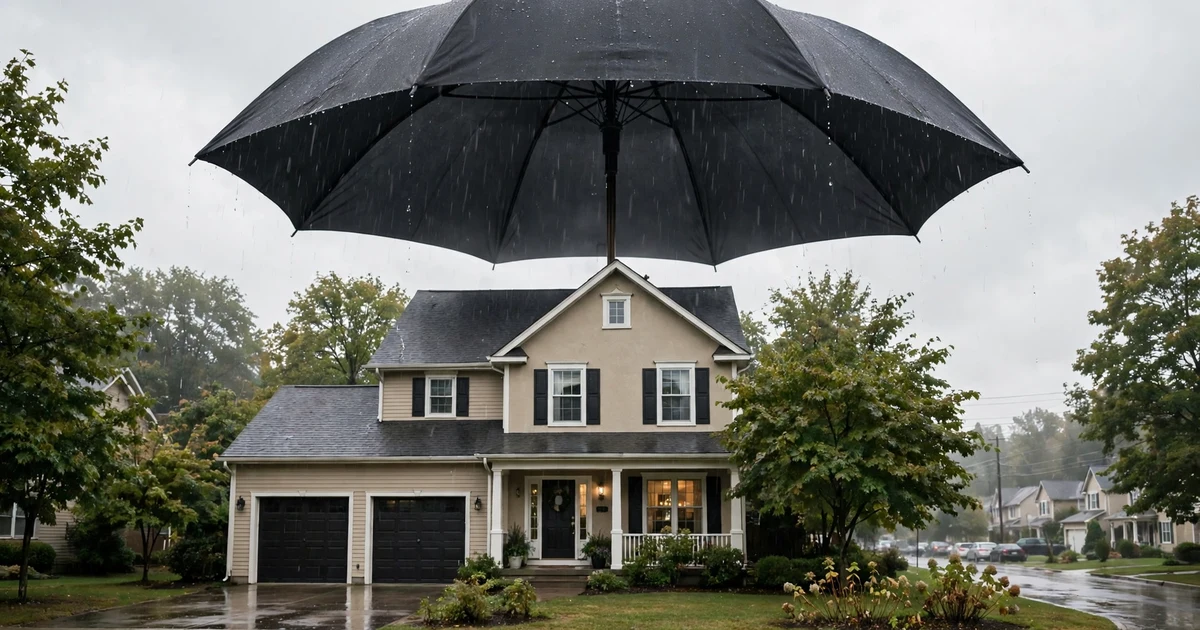
Most people buy liability insurance in pieces: a limit on the auto policy, a limit on the homeowners policy, a limit on the condo policy. Each piece has a cap, and each cap is a number most people chose once, years ago, and never thought about again. An umbrella policy exists for the day one of those caps turns out to be too small. It is an extra layer of liability coverage that sits on top of your other policies and pays when a claim runs past their limits — and, for a surprisingly small premium, it can add a million dollars or more of protection.
The headline price is genuinely low. A $1 million personal umbrella policy costs about $150 to $300 a year, and each additional $1 million costs roughly $50 to $75 a year — the Insurance Information Institute's published estimate, as reported by Real Cost Report 3. But the headline price is not the whole price, and that is where most umbrella guides fail their readers. Before an insurer will sell you the umbrella, you must raise the liability limits on the policies underneath it, and that step can add hundreds of dollars a year to your auto and home premiums. This guide gives you the full first-year cost, the limits you must carry first, what the umbrella actually covers, and how to decide how much you need.
What an umbrella policy does
An umbrella policy kicks in when you reach the limit on the underlying liability coverage in an auto, homeowners, renters, or condo policy 1. That sentence is the whole product in one line, but it is worth unpacking, because the mechanics decide whether the umbrella pays at all.
Imagine you cause a serious car crash and the other driver sues you for $800,000. Your auto policy has a $250,000 liability limit. It pays the first $250,000. Without an umbrella, the remaining $550,000 is your problem — your savings, your home equity, and, depending on your state's rules, a claim against your future income. With a $1 million umbrella policy, the umbrella pays the $550,000 above your auto limit, and you are covered up to $1.25 million in total for that claim. The umbrella does not pay the first dollar. It pays the dollars above the underlying limit, up to its own limit.
The same mechanics apply to a claim on your homeowners policy. A guest is badly hurt on your property and sues for $600,000. Your homeowners policy pays up to its liability limit — say $300,000 — and the umbrella pays the $300,000 above it. A claim that starts on your condo policy or your renters policy works the same way: the underlying policy pays first, up to its limit, and the umbrella takes over from there.
An umbrella policy also covers claims that standard policies often do not, such as libel and slander 1. If you are sued for something you wrote or said — a false statement about a neighbor, a damaging review, a social media post that crosses the line into defamation — your homeowners policy may not cover it at all, and the umbrella can be the only policy that responds. That coverage matters more than it used to, because more of daily life now happens in writing, in public, and in places where a careless sentence can become a lawsuit.
Two limits are worth stating plainly. An umbrella policy is not a substitute for the underlying policies: it does not pay your medical bills, repair your car, or rebuild your house. It only pays liability claims — money you owe other people because you are legally responsible for hurting them or damaging their property. And it only pays for claims the underlying policy would cover, once the underlying limit is exhausted. If the underlying policy excludes a claim entirely, the umbrella usually does not step in either.
What umbrella insurance costs
The cost question has two parts: the umbrella premium itself, and the cost of the underlying limits you must carry to buy it. Most guides print only the first part. This section prints both.
| Umbrella limit | Estimated annual premium |
|---|---|
| $1 million | About $150 to $300 a year |
| Each additional $1 million | Roughly $50 to $75 a year |
Source: the Insurance Information Institute's published estimate, as reported by Real Cost Report 3. The III article page itself does not print the dollar range; the range is the III's estimate as reported by that source. Real quotes run higher in some states.
Those numbers are national estimates, not quotes, and they are low for a reason: umbrella claims are rare. Most people who buy an umbrella policy never file a claim on it, and insurers price that rarity into the premium. The price also rises with risk. A household with a teenage driver, a pool, or a rental property will pay more than a household without them, and a driver with a history of accidents or violations will pay more still. The only way to know your price is to get a quote from your own insurer, with your own household on it.
The more useful number is the total. A $2 million umbrella costs about $200 to $375 a year by the III's estimate — the $150 to $300 for the first million, plus $50 to $75 for the second. A $5 million umbrella costs about $350 to $600 a year on the same math. Those are still small numbers next to the protection they buy. But they are not the full first-year cost, and the next section explains why.
The hidden first step: raise your underlying limits
Here is the step most umbrella guides leave out. Most insurers want about $250,000 of liability on your auto policy and $300,000 on your homeowners policy before selling you an umbrella policy 1. Those are not suggestions. They are the insurer's conditions, and the umbrella is built on top of them. If your auto policy carries only $100,000 of liability — a common limit — and your homeowners policy carries only $100,000, you cannot simply buy the umbrella and be done. You must raise the auto limit to $250,000 and the homeowners limit to $300,000 first, and those increases have their own price.
That price is the hidden part of the first-year cost, and it can be larger than the umbrella premium itself. Raising auto liability from $100,000 to $250,000 and homeowners liability from $100,000 to $300,000 can add hundreds of dollars a year to those two premiums combined, depending on your insurer, your driving record, and where you live. A shopper who budgets $200 for the umbrella and is quoted $600 for the total package has not been misled about the umbrella price — they have been surprised by the underlying increases, because no one told them to expect them. Expect them. When you ask for an umbrella quote, ask for the price of the underlying increases in the same conversation, and add the two numbers together before you decide whether the package is worth it.
There is a second reason the underlying limits matter, and it is not about price. The umbrella only pays above the underlying limit, so the underlying limit is the floor the umbrella stands on. If your underlying limits fall below the required levels — because you lowered them at renewal to save money, or because you switched insurers and the new policy carried a lower limit — the umbrella may not pay at all, or may pay only as if the required limit were still in place, leaving you to cover the gap. Keep the underlying limits where the umbrella requires them, and check them at every renewal. A cheaper renewal that quietly drops your auto liability from $250,000 to $100,000 can silently break the umbrella that sits on top of it.
The same rule applies to every policy the umbrella sits on. If the umbrella covers your condo policy and your renters policy as well as your auto and homeowners policies, each of those underlying policies must carry the liability limit the umbrella requires. Ask your insurer to list, in writing, the required underlying limit for each policy the umbrella covers, and keep that list with your declarations pages.
How much umbrella insurance do you need
Umbrella policies typically start at $1 million and are available up to $5 million or $10 million from most insurers 2. The $1 million starting point is not an accident: it is the amount that covers the great majority of liability claims, which rarely exceed a million dollars, while staying cheap enough that most households can afford it. But "most claims" is not the same as "your claim," and the right amount depends on what you have to lose and how likely a large claim is in your household.
The sizing question has three parts. First, add up what a lawsuit could take: your savings, your investments outside retirement accounts, the equity in your home, and, in many states, a portion of your future income. A household with $200,000 in savings and $300,000 in home equity has $500,000 at risk, and a $1 million umbrella covers it with room to spare. A household with $2.5 million at risk needs a larger umbrella. The limit should be at least as large as the assets a lawsuit could reach.
Second, think about your future income, not just your current savings. A young professional with modest savings today but a high income for decades ahead has more at risk than the bank balance suggests, because a large judgment can be collected against future earnings over many years. That is one reason financial planners often recommend umbrella coverage to younger households that do not feel wealthy yet: the wealth they are protecting is the income they have not earned.
Third, weigh the risk factors in your household. The Insurance Information Institute lists the factors that raise the chance of being sued: owning a pool and hosting pool parties, renting out a property, having a dog or a teenage driver in the house 2. Each of those raises the odds of a claim, and each of them raises the case for a higher limit.
| Risk factor | Why it raises the risk |
|---|---|
| Pool and pool parties | Guests, children, and alcohol around water; drowning and slip-and-fall claims are among the most serious |
| Rental property | Tenants and their guests; you are responsible for the condition of a property you do not live in |
| A dog in the house | Bite and injury claims, including claims from visitors and delivery workers |
| A teenage driver | A new driver in the household, with the highest crash rates of any age group |
Source: Insurance Information Institute, "Should I purchase an umbrella liability policy?" 2.
None of those factors means you will be sued. Most pool owners, landlords, dog owners, and parents of teenage drivers never face a liability claim. But the claims that do happen in those households tend to be larger, because they involve serious injuries — a child hurt in a pool, a tenant injured by a faulty stair, a bite that needs surgery, a crash caused by a new driver. A $1 million umbrella is the right starting point for most households with one of those factors. A household with two or three of them — a pool, a rental, and a teenage driver, for example — should price $2 million or $3 million and compare the cost, because the extra million costs only about $50 to $75 a year by the III's estimate.
One more factor: your public life. If you serve on a board, coach a team, or post often on social media, your exposure to a defamation claim is higher than a household that keeps to itself. An umbrella policy's coverage for libel and slander is part of what makes it worth pricing for those households, even if their assets are modest.
What it covers — and what it does not
The coverage question is best answered in two lists: what the umbrella adds, and what it never was.
What it adds is a large layer of liability protection on top of your auto, homeowners, renters, or condo policy, and coverage for claims such as libel and slander that standard policies often do not cover 1. A car crash that injures several people, a guest who is seriously hurt on your property, a dog bite that needs surgery, a defamation claim over something you posted — those are the claims an umbrella is built for. It can also cover claims that arise while you are traveling, and claims involving a rental car or a boat, depending on the policy, so ask your insurer what is included rather than assuming the umbrella follows you everywhere.
What it does not add is first-party coverage. An umbrella policy does not pay for your own injuries, your own car, your own house, or your own belongings. If you are hurt in a crash you caused, your health insurance and your auto policy's medical coverage pay your bills, not the umbrella. If your house burns down, your homeowners policy pays to rebuild it, not the umbrella. The umbrella only pays money you owe to other people, and only when the underlying policy's limit has been reached or the claim is one the underlying policy does not cover at all, like libel and slander.
It also does not cover everything you might be sued for. Most umbrella policies exclude claims arising from a business you run, professional malpractice, intentional harm, and criminal acts. A home-based business needs its own business liability policy, and no policy covers a harm you caused on purpose. If you run a business from your home, tell your insurer, because the umbrella may not cover a claim that arises from the business, and the homeowners policy may not either.
Finally, an umbrella policy does not cover the underlying policy's deductible. Most umbrella policies do pay defense costs above the underlying limit, and many pay them in addition to the limit rather than inside it, but the details vary by insurer. Ask whether defense costs are inside or outside the limit, because a long lawsuit can cost hundreds of thousands of dollars in legal fees alone.
Who should consider an umbrella policy

The short answer is: anyone with something to lose. The longer answer is that the case is strongest for four groups, and if you are in one of them, the umbrella deserves a quote even if you have never thought about it before.
The first group is homeowners with equity. If your house is worth much more than your mortgage, that equity is an asset a lawsuit can reach. A $300,000 homeowners liability limit sounds large until it is measured against $400,000 of equity and a serious injury claim. The umbrella closes that gap for about $150 to $300 a year.
The second group is households with a teenage driver. A new driver is the single biggest liability risk most families will ever carry, and the crash that worries insurers is not the fender-bender in the school parking lot — it is the serious crash with multiple injured people, where the claims can run past the auto policy's limit in a single afternoon. If a teenager is about to start driving, price the umbrella in the same month you add them to the auto policy.
The third group is landlords and pool owners. A rental property puts you legally responsible for a building you do not live in, and a pool puts you responsible for one of the most dangerous features a home can have. Both are named by the III as factors that raise the chance of being sued 2, and both are reasons to carry more than the minimum underlying limits even before the umbrella is considered.
The fourth group is anyone with a public or professional life that creates defamation exposure: board members, coaches, landlords, small business owners, and people who post often online. The libel and slander coverage in an umbrella policy is the part of the product that has no equivalent in a standard homeowners policy, and for those households it can be the main reason to buy.
If you are in none of those groups — a renter with modest savings, no car, no dog, no pool, no rental, and no teenage driver — a $1 million umbrella is still cheap, and it is still worth a quote, because the underlying renters liability limit is usually low and a single serious claim could exceed it. But the urgency is lower, and the decision can wait until your assets or your household changes.
How to buy umbrella insurance: a short checklist

Buying an umbrella policy well takes one phone call, not a week of research, but the order of the call matters. Start with your current insurer, because most umbrella policies are sold by the same company that writes the underlying auto and homeowners policies, and bundling them together is usually cheaper than buying the umbrella from a different company. A standalone umbrella from a second insurer is possible, but it can create gaps between the two companies' policies, and it usually costs more.
First, ask your insurer for the required underlying limits in writing: the auto liability limit and the homeowners liability limit the umbrella requires, and whether the same requirement applies to your condo or renters policy if the umbrella covers those too. Most insurers want about $250,000 on auto and $300,000 on homeowners 1. Write those numbers down, and ask for the price of raising your current limits to those levels.
Second, ask for the total price, not just the umbrella premium. Get the umbrella quote for $1 million, for $2 million, and for $3 million, and get the price of the underlying increases alongside them. Add each umbrella premium to the underlying increases to get the true annual cost of each option, and compare the three totals. The jump from $1 million to $2 million is usually about $50 to $75 a year for the umbrella itself, and nothing extra for the underlying limits, because the underlying requirements are the same at every umbrella limit. That makes the second million the cheapest million you will ever buy.
Third, ask the three questions that separate a good umbrella policy from a thin one. Does it cover libel and slander? Are defense costs paid in addition to the limit, or inside it? And does it cover claims while you travel or drive a rental car? The answers vary by insurer, and they are worth more than a small difference in premium.
Fourth, decide the limit from your assets, not from the price. Add up your savings, your investments outside retirement accounts, and your home equity, and choose a limit at least as large as that total. Then add a million if your household carries two or more of the III's risk factors — a pool, a rental, a dog, a teenage driver 2. The extra premium is small, and the protection it buys is the kind you only notice when you need it.
Finally, set a reminder to check the underlying limits at every renewal. The umbrella is only as strong as the policies underneath it, and a renewal that quietly lowers an underlying limit can break it without you noticing. Keep the required limits list with your declarations pages, and read the declarations pages once a year. The umbrella itself needs little attention once it is in place — but the foundation it stands on needs checking every year.
Verified against the Insurance Information Institute on November 20, 2026.
The bottom line
An umbrella policy is the cheapest million dollars of liability protection most households can buy: about $150 to $300 a year for $1 million, and roughly $50 to $75 a year for each additional million, by the Insurance Information Institute's estimate 3. But the headline price is not the whole price. Most insurers require about $250,000 of liability on your auto policy and $300,000 on your homeowners policy first 1, and raising those limits can add hundreds a year to your auto and home premiums. Price the whole package, not just the umbrella. Then size the limit to what a lawsuit could actually take — your savings, your home equity, and your future income — and add more if your household carries a pool, a rental property, a dog, or a teenage driver. Do that, and the umbrella does what it is named for: it covers you when the storm is bigger than the policy underneath it.
Frequently asked questions
- What is umbrella insurance?
- Umbrella insurance is extra liability coverage that sits on top of your auto, homeowners, renters, or condo policy. When a covered claim reaches the limit of the underlying policy, the umbrella policy pays the rest, up to its own limit.
- How much does umbrella insurance cost?
- A $1 million personal umbrella policy costs about $150 to $300 a year, and each additional $1 million costs roughly $50 to $75 a year, according to the Insurance Information Institute. Real quotes run higher in some states, and the cost of raising your underlying limits is on top of that.
- How much liability coverage do I need before I can buy an umbrella policy?
- Most insurers want about $250,000 of liability on your auto policy and $300,000 on your homeowners policy before selling you an umbrella policy. Those underlying limits must stay in place for the umbrella to pay.
- How much umbrella insurance do I need?
- Umbrella policies typically start at $1 million and are available up to $5 million or $10 million from most insurers. Weigh the value of your savings, your home equity, and your future income, plus the risk factors in your household, such as a pool, a rental property, a dog, or a teenage driver.
- What does umbrella insurance cover that my home and auto policies do not?
- An umbrella policy covers claims such as libel and slander that standard policies often do not, and it adds a large extra layer of liability protection on top of your auto, homeowners, renters, or condo policy when a claim exceeds those limits.
- Who should consider buying umbrella insurance?
- Anyone with savings, home equity, or future income worth protecting should consider it, and the case is stronger if you own a pool and host pool parties, rent out a property, have a dog, or have a teenage driver in the house — the risk factors the Insurance Information Institute lists.
Sources
Numbers in the text point to these publications. Links open the original source.
- Insurance Information Institute (Triple-I). What is an umbrella liability policy?
- Insurance Information Institute (Triple-I). Should I purchase an umbrella liability policy?
- Real Cost Report. Umbrella Insurance Cost 2026: How Much Coverage Is Worth It & When to Buy
Related guides
- What Does Homeowners Insurance Cover? (And What It Does Not Cover)
A standard homeowners policy covers your dwelling, other structures, belongings, living expenses, and liability — but not floods or earthquakes.
- How Much Does Homeowners Insurance Cost? Average Rates by State
The official NAIC average HO-3 premium was $1,737 a year in 2023 data, while modeled 2026 quotes average $2,490 for $400,000 of dwelling coverage.
- What Is Homeowners Insurance and How Does It Work?
Homeowners insurance is a contract that pays to repair or rebuild your home after a covered loss and protects you if someone is hurt on your property.
This guide is general educational information, not insurance, legal or financial advice. Insurance rules and prices vary by state, company and personal circumstances. Confirm anything important with your state insurance department or a licensed professional. Read the full disclaimer.