Home Insurance, coverage types
Mobile Home Insurance: What an HO-7 Policy Covers, What It Costs, and the Valuation Trap
A manufactured home is not a site-built house, and a standard homeowners policy does not cover it. Here is what an HO-7 policy actually pays for, what it costs, and the one choice — replacement cost versus actual cash value — that decides whether a total loss ruins you.
- By
- Ella H.
- Published
- Updated
- Reading time
- 15 min read
Key takeaways
- A standard homeowners policy does not cover a manufactured home. You need a specialized HO-7 policy, and a modular home is the exception — it is insured with a standard HO-3 policy.
- The valuation basis matters more than the premium. An actual cash value policy on a depreciating manufactured home can pay far less than rebuilding costs; replacement cost or agreed-value coverage closes that gap.
- For a 10-year-old single-wide, ValuePenguin's 2026 sample quotes ran from $969 a year (Assurant) to $1,607 (Foremost) — and the same home cost $969 in Indianapolis but $1,607 in Austin.
- About 35% of manufactured-home owners have no insurance at all, even though a lender requires it while there is a loan and many parks require it too.
- In California, SB 525 took effect January 1, 2026: the FAIR Plan must now insure manufactured homes on the same terms as other homes, including full replacement cost — but it is fire coverage only, so you still need a companion policy.
In this guide
- What "mobile home" actually means
- What an HO-7 policy covers
- What the policy covers inside your home
- Replacement cost vs actual cash value: the valuation trap
- What an HO-7 does not cover
- How much mobile home insurance costs
- Do you need it? The 35% who go without
- Older homes, seasonal homes, and rentals
- What changed in 2026: California's FAIR Plan now covers manufactured homes
- How to buy the right policy
- The bottom line
- Frequently asked questions
- Sources
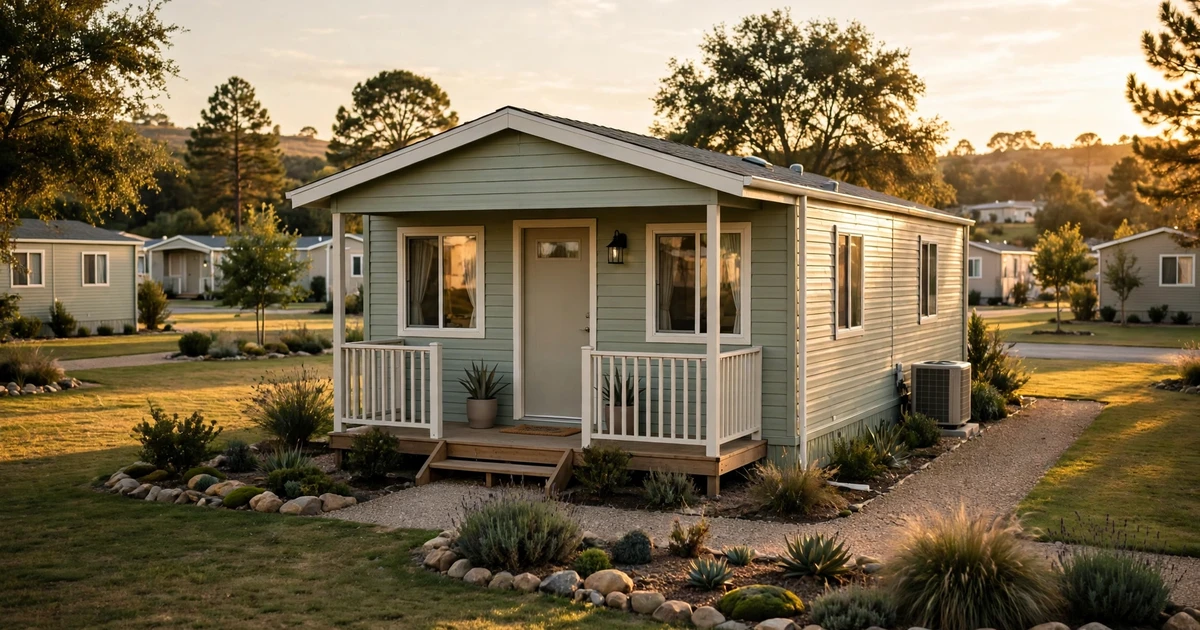
More than 20 million Americans live in manufactured homes, and about 8.5 million manufactured and mobile units make up 5.6% of all U.S. housing stock 8. Yet a third of the people who own one have no insurance on it at all — and many of the rest are holding a policy that would pay far less than they expect after a fire or a storm. The problem is not that coverage does not exist. It is that a manufactured home is insured on a different form, under different rules, than a site-built house, and the words on the policy — especially "actual cash value" — work differently than most owners assume.
This guide explains what a mobile home policy is, what it covers and what it leaves out, what it costs in 2026, and the single decision that matters most: how your home's value is calculated when it is destroyed. It also covers what changed in California on January 1, 2026, when the state's FAIR Plan finally had to start insuring manufactured homes on the same terms as other homes 9.
What "mobile home" actually means

The first thing to get straight is the vocabulary, because the words decide which policy you buy. Legally, "mobile home" means a factory-built home produced before June 15, 1976, the date the federal HUD construction code took effect. Homes built on or after that date to the HUD Code are "manufactured homes" 1 4. In everyday speech people use the two terms interchangeably, and insurers usually do too — but the 1976 line matters, because homes built before it were built with no federal construction standards at all, and some insurers will not insure them.
A modular home is a different thing entirely. Modular homes are built in sections in a factory, but they are built to local building codes, delivered to a permanent foundation, and finished on site. For insurance purposes they are treated like site-built houses and insured with a standard homeowners (HO-3) policy, not an HO-7 1 4.
How do you tell which one you have? A HUD-code manufactured home carries a HUD certification label — a red metal tag — on the outside of the home 4. If you are buying a home or shopping for a policy, find that tag before you do anything else. It settles the question, and an insurer will ask about it.
Two more categories cause confusion. Park-model homes and tiny homes are not manufactured homes: park models are built to ANSI codes and titled as RVs, and tiny homes rarely exceed 500 square feet and are also titled as RVs — both may be excluded from manufactured-home policies 4. If your home is titled as an RV, you probably need an RV policy, not an HO-7.
What an HO-7 policy covers
A standard homeowners policy does not cover a manufactured home. Manufactured homes are insured on a specialized form, usually called an HO-7 (Manufactured Home Form) 1 3. The form covers two basic kinds of risk: physical damage and personal liability 2.
Physical damage pays for accidental damage to the home itself, your belongings, and other structures — attached patios and decks, garages, and storage sheds — from fire, hail, wind, theft, vandalism, or falling objects 2. That "other structures" part is easy to overlook, and it is worth checking on your declarations page: the deck and the shed are often a meaningful share of what you own, and they are covered only up to the limits you bought for them.
Personal liability covers claims and lawsuits when someone is injured or their property is damaged because of your activities — medical expenses, lost wages, pain and suffering, and property damage to others 2. One limit matters here: liability coverage does not cover injuries to you or members of your household. If you are hurt in your own home, your health insurance responds, not your liability coverage.
Coverage is generally available whether the home is a primary residence, a rental, a commercial property, a seasonal home, or a home in a park or on private land 2. But the details change with the use — a seasonal home and a rented home are not insured the same way as a year-round primary residence, and that is covered below.
What the policy covers inside your home

The contents of a manufactured home — furniture, appliances, clothing, electronics — are covered under the personal property part of the policy, the same way contents are covered in a site-built house. But two details deserve attention.
First, most mobile home policies are named-peril policies: they pay only for the causes of loss listed in the policy. Some companies offer broader open-peril coverage, which protects against all risks except those specifically excluded 1. The difference shows up in the claims nobody expects. A named-peril policy that lists fire, wind, and theft will not pay for a cause of loss that is not on the list. If you are comparing two quotes and one is cheaper, check whether it is named-peril and the other is open-peril before you decide the cheaper one is a bargain.
Second, personal property limits and the valuation basis apply to contents too. A policy that pays actual cash value on the structure usually pays actual cash value on contents as well — which means your ten-year-old sofa is worth very little at claim time, even though replacing it costs real money. Ask your insurer whether replacement cost is available for contents, and what it costs to add.
Replacement cost vs actual cash value: the valuation trap
This is the most important section in this guide, and the one most ranking pages explain in a single sentence. Manufactured homes depreciate. A site-built house usually gains value over time because the land underneath it gains value; a manufactured home, especially one in a park where the owner does not own the land, typically loses value as it ages. That depreciation is the trap.
An actual cash value (ACV) policy pays the home's value at the time of the loss — its replacement cost minus depreciation. If your home would cost $90,000 to replace but has depreciated to $40,000, an ACV policy pays $40,000 (minus your deductible). You cannot rebuild with that. You are left with a destroyed home, a check that does not cover a replacement, and, if you still owe money on the home, a loan balance that may be larger than the check.
A replacement cost policy pays what it actually takes to rebuild or replace the home with one of like kind and quality, without deducting for depreciation. It costs more, and for a manufactured home it is the coverage that actually does the job the owner thinks they bought.
There is a third option worth knowing about. Some insurers offer agreed loss settlement: if the home is destroyed by a covered event, you receive the full insured amount minus the deductible, with no depreciation argument at all. Farmers' manufactured-home policies, for example, use broader open-peril-style coverage for the dwelling and belongings and include agreed loss settlement as standard 5 1.
The social threads about manufactured-home insurance in 2026 keep coming back to this point. Homeowners report premiums jumping and policies being dropped, and the recurring advice from other owners is blunt: insure the contents, because the insurer "does not want to give you anything on the home itself." That is the ACV trap in plain language. Before you buy or renew, ask your insurer three questions and get the answers in writing: Is this policy replacement cost or actual cash value? What is the insured value of the home? And if the home is a total loss tomorrow, exactly how much would I receive?
What an HO-7 does not cover
No policy covers everything, and the exclusions on an HO-7 are the ones that surprise owners most.
Flood is not covered by a mobile home policy, the same as with standard homeowners insurance — if your home is in a flood zone, you need separate flood insurance 2 1. Manufactured homes in parks are often sited on low-lying land, so this is not a remote risk. Check whether your park is in a flood zone before you decide you do not need the coverage.
Transit is generally not covered. Coverage under a regular policy does not apply while the home is in transit. Some insurers offer temporary coverage or an endorsement for physical damage while the home is being moved, and trip collision coverage is sold as an add-on by insurers including Allstate, Foremost, and Progressive 2 1. If you are moving a home — even a short distance — arrange this before the truck leaves.
Wear and tear, neglect, and maintenance problems are not covered, and neither is damage that builds up slowly, like a roof that has been leaking for a year. A policy covers sudden, accidental damage. A home that has been left to deteriorate will have claims denied, and a pattern of claims makes the next renewal harder.
How much mobile home insurance costs
There is no single average premium for manufactured homes, and any page that prints one without saying what home it assumes is misleading you. The honest answer is a range with the method attached.
ValuePenguin published sample quotes in 2026, updated July 6, 2026, for a specific home: a 10-year-old single-wide in a park, with a dwelling value of $51,000 to $63,000, $100,000 of liability coverage, and a $1,000 deductible. For that home, the quotes were Assurant $969 a year, American Modern $1,025 a year, and Foremost $1,607 a year 1. The same $63,000 home cost $969 a year in Indianapolis and $1,607 a year in Austin — the same house, the same coverage, a $638 difference because of where it sits 1. Across the sample, rates ranged from under $1,000 a year to nearly $2,500 a year 1.
| Insurer | Annual premium, 10-year-old single-wide |
|---|---|
| Assurant | $969 |
| American Modern | $1,025 |
| Foremost | $1,607 |
Source: ValuePenguin sample quotes, updated July 6, 2026; 10-year-old single-wide in a park, dwelling $51,000–$63,000, liability $100,000, deductible $1,000 1.
The broader 2026 guides cluster around $700 to $1,500 a year for a typical policy. Low-risk Midwest states run about $400 to $800 a year, while Florida, coastal areas, and hurricane-exposed regions run $1,400 to $3,500 or more a year 1 3. State-by-state premium tables circulate online, but they conflict with each other and with the quoted figures, and most show no method — treat them with suspicion and anchor on the sample quotes above, which state exactly what home they price.
What moves the price? The home's age and value, its location and exposure to wind and hail, the valuation basis you choose, your deductible, your claims history, and whether the home is tied down and skirted properly. Premiums have risen in 2026 along with the replacement costs of materials and labor, and carriers have been non-renewing older homes in Gulf Coast states 3. That is why a quote that was competitive two years ago may not be competitive now — and why shopping at renewal is worth the hour it takes.
To put the cost in context, a new manufactured home is not a small asset. The Census Manufactured Housing Survey put the average sales price of a new manufactured home at $134,800 in February 2026 — $89,100 for a single-section home and $163,100 for a double-section home — and the 2025 annual average was $127,200 7. Those prices are for the home alone and exclude land, site preparation, foundation, delivery, and installation 7. A policy that costs roughly $1,000 a year protects an asset worth well over $100,000. The problem is not the price of the premium. It is the price of the wrong valuation basis.
Do you need it? The 35% who go without
There is no law saying you must have mobile home insurance if the mortgage is paid off and the park does not require it 1. But that legal fact hides a striking one: according to the Consumer Federation of America, using 2021 American Housing Survey data, 35% of owners of manufactured homes lack homeowners insurance, compared with 7.4% of all homeowners — 6.1 million homes carrying $1.6 trillion in unprotected value 6.
The uninsured are not evenly spread. Only 2% of homeowners with a mortgage reported having no insurance — because a lender requires it while there is a loan. The uninsured are overwhelmingly owners who paid off or inherited their homes 6. In other words, the people most likely to go without coverage are the people who own their home free and clear — the same people who would have to pay for a rebuild entirely out of pocket if the home burned.
Two practical requirements push most owners toward coverage anyway. A lender will require insurance while there is a loan, and many mobile home parks require a policy with a set liability amount 1. If your park requires, say, $100,000 or $300,000 of liability coverage, that number is on your lease or park rules — check it before you buy, because a policy that meets the park's requirement and one that does not are priced differently, and a policy that falls short can be a lease violation.
If you own outright and the park does not require coverage, the question is a financial one, not a legal one. A manufactured home is usually the largest asset its owner has. A fire, a tornado, or a burst pipe in an empty home can destroy it in an afternoon. The premium for a typical policy is roughly $700 to $1,500 a year. The loss without one is the home.
Older homes, seasonal homes, and rentals
Older homes are harder to insure. Homes built before June 15, 1976 were built with no federal construction standards, so some insurers will not insure them at all, and others charge higher rates or limit coverage. Outdated wiring or plumbing, or more than one prior claim, also makes coverage harder to find 1. If you own a pre-1976 home, start shopping early — the standard market may not take it, and you may need a surplus-lines insurer or your state's FAIR Plan.
A home lived in only part of the year may need a seasonal policy. Empty homes face more theft and vandalism, and water damage that goes unnoticed for weeks instead of hours. Tell your insurer the home is seasonal rather than letting them discover it after a claim 1.
Renting out a mobile home usually needs landlord insurance, not a standard HO-7 1. A standard HO-7 is written for an owner-occupied home. If tenants move in — even family members paying rent — the risk changes, and a claim on an owner-occupied policy for a tenant-occupied home can be denied. If you rent the home, even occasionally, say so when you buy the policy.
What changed in 2026: California's FAIR Plan now covers manufactured homes
California passed SB 525, effective January 1, 2026, and it changed something that had been true for years: the California FAIR Plan — the state's insurer of last resort — must now insure manufactured homes and mobilehomes under the same terms and conditions as basic property insurance for other residential dwellings, including full replacement cost coverage 9.
Before this law, the FAIR Plan offered manufactured homes only actual cash value coverage, and full replacement cost coverage was, in the words of the bill's supporters, "next to impossible" to find in California 9. The law affects over 500,000 mobile homes in California 9. For owners who could not buy replacement cost coverage in the regular market, the FAIR Plan is now a real option.
There is a limit to understand. The FAIR Plan is fire coverage only — fire, lightning, smoke, and internal explosion, with wind, hail, and vandalism available as options. It does not cover theft, water damage, or liability, so owners still need a companion policy for the rest 9. The FAIR Plan is a backstop, not a complete policy. But for a California owner whose home was previously uninsurable at replacement cost, January 1, 2026 was the date the door opened.
How to buy the right policy
Start with the home itself: its year of manufacture, its size, whether it is single- or double-section, where it sits, and whether you own the land or rent a lot in a park. Then get quotes from at least three insurers that actually write manufactured-home policies — not every company does, and a company that writes HO-3 policies may not write HO-7s at all.
Compare the quotes on the same basis: the same dwelling limit, the same liability limit, the same deductible, and — most important — the same valuation basis. A quote that looks cheap because it is actual cash value is not comparable with a replacement cost quote, and the difference in protection is worth far more than the difference in premium.
Ask each insurer, in writing: Is this replacement cost or actual cash value? Is replacement cost available for contents as well as the structure? Is the policy named-peril or open-peril? What is the deductible, and is there a separate, higher deductible for wind or hail? Does the policy cover the home while it is being moved? And if the home is a total loss, exactly how much would I receive?
Then read the declarations page when the policy arrives, and check the numbers against the quotes. The dwelling limit should reflect what it would cost to replace the home today, not what you paid for it ten years ago. If the limit has not moved in years while building costs have risen, ask for a revaluation. An underinsured home is the quiet version of the ACV trap: the policy pays replacement cost, but only up to a limit that no longer replaces anything.
Verified against Triple-I, ValuePenguin (updated July 6, 2026), the Consumer Federation of America, the Census Manufactured Housing Survey, and the California FAIR Plan / SB 525 on November 23, 2026.
The bottom line
A manufactured home needs a specialized HO-7 policy — a standard homeowners policy does not cover it — and the most important choice on that policy is not the premium but the valuation basis. An actual cash value policy on a depreciating home can pay far less than rebuilding costs, while replacement cost or agreed-value coverage pays what it actually takes to put a roof back over your head. For a 10-year-old single-wide, 2026 sample quotes ran from $969 to $1,607 a year, and most typical policies cluster around $700 to $1,500 — a small price against an asset worth more than $100,000. About 35% of manufactured-home owners carry no insurance at all, mostly owners who paid off or inherited their homes, and they are the ones with the most to lose. If you own a manufactured home, check your declarations page today: confirm the policy is an HO-7, confirm it is replacement cost, and confirm the dwelling limit still covers a rebuild. In California, the FAIR Plan has had to insure manufactured homes at full replacement cost since January 1, 2026 — if your home was uninsurable before, it may not be now.
Frequently asked questions
- Is mobile home insurance the same as homeowners insurance?
- No. A standard homeowners policy (HO-3) does not cover a manufactured home. Manufactured homes are insured on a specialized form, usually called an HO-7. Modular homes are the exception: they are built to local building codes on a permanent foundation and are insured with a standard HO-3 policy.
- How much does mobile home insurance cost?
- Most 2026 guides cluster around $700 to $1,500 a year for a typical policy. ValuePenguin's sample quotes for a 10-year-old single-wide in a park ran from $969 a year (Assurant) to $1,607 (Foremost). Location matters a lot: the same $63,000 home cost $969 a year in Indianapolis and $1,607 in Austin.
- What is the difference between replacement cost and actual cash value for a mobile home?
- Replacement cost pays what it takes to rebuild or replace the home with one of like kind and quality, without deducting for depreciation. Actual cash value pays the home's depreciated value, which can be far less than rebuilding costs because manufactured homes lose value over time. Some insurers offer agreed loss settlement, which pays the full insured amount minus the deductible with no depreciation argument.
- Do I legally need mobile home insurance?
- There is no law requiring it if you own the home outright and your park does not require it. But a lender will require it while there is a loan, and many mobile home parks require a policy with a set liability amount. About 35% of manufactured-home owners have no insurance, and the uninsured are overwhelmingly owners who paid off or inherited their homes.
- Does mobile home insurance cover flood damage?
- No. Flood is not covered by a mobile home policy, just as it is not covered by a standard homeowners policy. If your home is in a flood zone, you need separate flood insurance.
- Can I get coverage for an older mobile home built before 1976?
- It is harder. Homes built before June 15, 1976 were built with no federal construction standards, so some insurers will not insure them at all, and others charge higher rates or limit coverage. Outdated wiring or plumbing and more than one prior claim also make coverage harder to find.
Sources
Numbers in the text point to these publications. Links open the original source.
- ValuePenguin. Mobile Home Insurance: Cost, Coverage and Best Companies (updated July 6, 2026)
- Insurance Information Institute (Triple-I). Mobile home insurance (accessed November 23, 2026)
- MoneyGeek. Mobile Home Insurance: What Is It & Where to Buy (updated November 2026)
- Oregon Department of Consumer and Business Services, Division of Financial Regulation. Manufactured Home Insurance (publication 440-5806)
- Farmers Insurance. Mobile & Manufactured Home Insurance (accessed November 23, 2026)
- Consumer Federation of America. EXPOSED: A Report on 1.6 Trillion Dollars of Uninsured American Homes (March 12, 2024; 2021 American Housing Survey data)
- U.S. Census Bureau via FRED (St. Louis Fed). Average Sales Price of New Manufactured Homes: Total Homes in the United States, Manufactured Housing Survey (monthly series, last updated November 5, 2026)
- Oak Ridge National Laboratory / HUD (Ed Hudson presentation). Housing Stock: Manufactured Housing (2026 ORNL presentation; occupied U.S. housing stock 2025, Census Bureau data)
- California State Senate, District 40 (Sen. Brian W. Jones). Leader Jones' mobile home insurance bill signed into law (SB 525, Chapter 476, Statutes of 2025; effective January 1, 2026)
Related guides
- What Does Homeowners Insurance Cover? (And What It Does Not Cover)
A standard homeowners policy covers your dwelling, other structures, belongings, living expenses, and liability — but not floods or earthquakes.
- Homeowners Insurance Deductible: Flat vs Percentage, and How It Changes Your Premium
What you pay before your insurer pays. Flat vs percentage deductibles, hurricane deductibles in 19 states, and how raising yours changes your premium.
- What Is Homeowners Insurance and How Does It Work?
Homeowners insurance is a contract that pays to repair or rebuild your home after a covered loss and protects you if someone is hurt on your property.
This guide is general educational information, not insurance, legal or financial advice. Insurance rules and prices vary by state, company and personal circumstances. Confirm anything important with your state insurance department or a licensed professional. Read the full disclaimer.