Car Insurance, coverage types
Non-Owner Car Insurance: What It Covers, What It Costs, and Who Needs It
No car, no insurance — until the state suspends your license for having none. A non-owner policy closes that gap for about $41 a month.
- By
- Ella H.
- Published
- Updated
- Reading time
- 14 min read
Key takeaways
- A non-owner policy is liability-only coverage that follows you as the driver, not a car. It costs about $486–$506 a year in 2026 — roughly $41–$42 a month.
- It pays for injuries and property damage you cause to others in a borrowed or rented car. It never pays for damage to the car you are driving — that is the owner's policy, a rental waiver, or a credit card benefit.
- It is secondary coverage: the vehicle owner's policy pays first, and yours pays the remainder up to your limits.
- The most common reason to buy one is an SR-22: if you do not own a car, you buy a non-owner policy and the insurer files the SR-22 against it. Only four states do not use SR-22s at all.
- A non-owner policy keeps your insurance history continuous, so a gap between cars does not raise your rates later — but it is not sold online by most insurers, so buy it by phone or through an agent.
In this guide
- What non-owner car insurance is
- Non-owner insurance and rental cars
- Who needs one — and who does not
- How much does non-owner car insurance cost?
- Non-owner SR-22: the license catch-22
- Why uninsured motorist coverage matters on a non-owner policy
- How to buy a non-owner policy
- The bottom line
- Frequently asked questions
- Sources
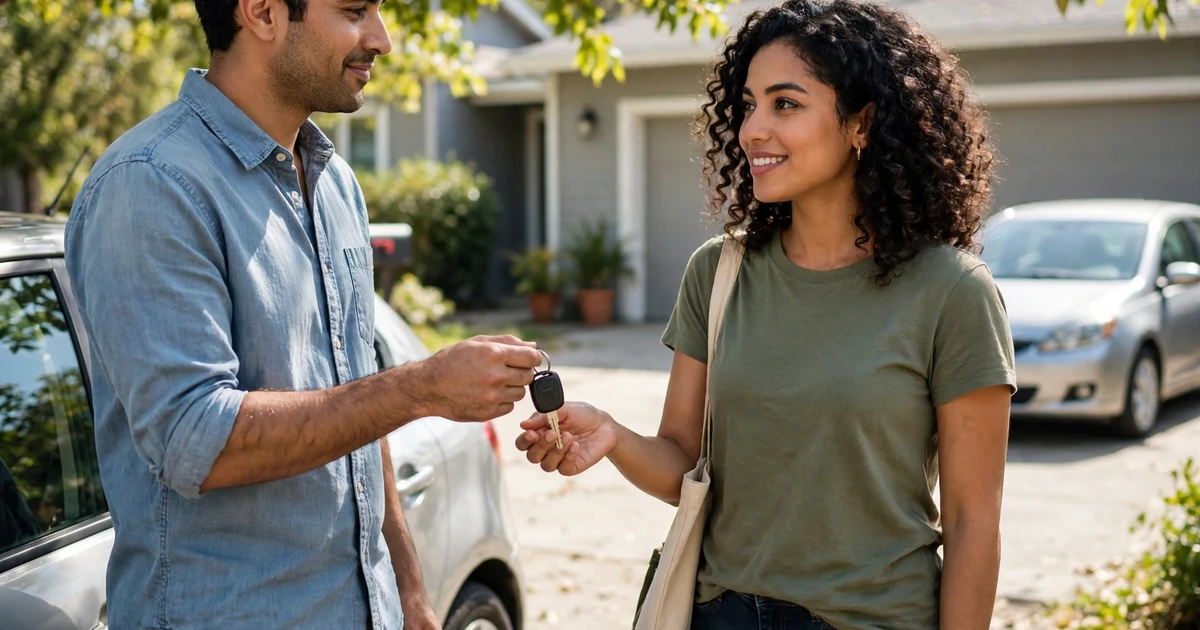
Here is a trap that catches thousands of drivers every year: you do not own a car, so you do not buy car insurance — and then the state suspends your license for not having insurance. It sounds like a riddle, but it is real. In early 2025, a viral Instagram post described exactly this catch-22 in Virginia: a license suspended for no insurance, while owning no car to insure. The fix is a product most drivers have never heard of: non-owner car insurance.
A non-owner policy is a liability-only policy for people who do not own a vehicle but still drive — borrowed cars, rentals, car-sharing services. It follows you as the driver, not a car. It costs about $486–$506 a year in 2026, roughly $41–$42 a month, according to two studies of the same data published this year 1 2. And for one group of drivers — people who need an SR-22 to get their license back — it is not optional. It is the only way to satisfy the state without buying a car.
The big comparison brands mostly ignore this product. NerdWallet, Forbes Advisor, Bankrate, ValuePenguin, Policygenius, and The Zebra have no dedicated non-owner guide surfacing in search; the field is led by Insurance.com, Insure.com, and CarInsurance.com — all owned by the same company, all using the same Quadrant data — plus insurer pages. This guide is independent of that dataset where it matters: it shows both published averages and explains why they differ, leads with the exclusions instead of burying them, and covers the SR-22 overlap in one place.
What non-owner car insurance is
A non-owner policy is a liability-only policy for people who do not own a vehicle but drive cars owned by others, rent cars, or use car-sharing services. It follows you as the driver, not a car 1 2. That is the whole idea in one sentence, and the "not a car" part is what makes it different from every other car insurance policy you have seen.
It is also secondary coverage. When you borrow a car and cause a crash, the vehicle owner's policy pays first. Your non-owner policy pays the remainder, up to your limits, if the owner's coverage runs out 1. Think of it as a backup layer that travels with you from car to car, rather than a policy tied to one vehicle.
What it covers is straightforward. In all states, it covers bodily injury liability and property damage liability you cause to others — the medical bills and repair costs of the people you hurt or whose property you damage. In some states, where the law requires it, it also includes personal injury protection or medical payments and uninsured/underinsured motorist coverage. Some policies offer uninsured/underinsured motorist coverage and medical payments as optional add-ons 1 3.
What it does not cover is just as important, and it is where most misunderstandings live. A non-owner policy does not cover damage to the car you are driving — collision and comprehensive coverage belong to the owner's policy, a rental damage waiver, or a credit card benefit. It does not cover theft or vandalism of that car, your own injuries in states without no-fault coverage, towing and labor, or rental reimbursement. It does not cover vehicles you own or that are regularly available to you, such as a household member's car. And it does not cover business use 1 3.
| Covered | Not covered |
|---|---|
| Bodily injury liability you cause to others | Damage to the car you are driving |
| Property damage liability you cause to others | Theft or vandalism of that car |
| PIP / medical payments where state law requires it | Your own injuries in states without no-fault coverage |
| Uninsured / underinsured motorist coverage where required or added | Towing, labor, and rental reimbursement |
| Liability in a rental car | Vehicles you own or regularly use, and business use |
Sources: Insurance.com 2026 non-owner analysis; Progressive non-owner SR-22 page 1 3.
One exclusion deserves emphasis, because several aggregator pages imply the opposite: a non-owner policy is not a complete substitute for regular car insurance. It is a liability layer for someone who does not own a car. If you own a car, you need a regular policy. If you drive a household member's car every day, you need to be added to that household's policy — most insurers require all licensed household drivers to be listed 1.
Non-owner insurance and rental cars

The rental counter is where most people first meet the non-owner question. You rent a car for a weekend, and the agent offers you liability coverage for $10 to $15 a day, plus a damage waiver on top. Is it worth buying a year-round non-owner policy instead? For a frequent renter, the math is worth doing: at roughly $41 a month, a non-owner policy costs about the same as three or four days of rental-counter liability coverage — and it covers you all year, in any car you borrow or rent.
But understand exactly what each piece pays for. A non-owner policy covers your liability in a rental car — the injuries and property damage you cause to other people. It does not cover damage to the rental car itself. For that, you buy the rental company's physical-damage waiver, or you use a credit card that provides rental car damage coverage — and you must use that card to pay for the rental 1.
So the right combination for a frequent renter is usually a non-owner policy for liability plus a credit card with rental damage coverage for the car itself. That combination replaces both add-ons at the rental counter. What it does not replace is the rental company's own insurance if you want to walk away from the counter with zero paperwork — but it is far cheaper over a year of rentals.
The same logic applies to car-sharing services. If you use a service regularly, a non-owner policy covers your liability in the shared car, on the same terms as in a borrowed car. Check the car-sharing service's own coverage first: many include liability coverage in the rental price, which may make a non-owner policy unnecessary for that use — but it would still cover you in a friend's car or a traditional rental.
Who needs one — and who does not
You need a non-owner policy if you do not own a car and you often drive cars owned by someone else, frequently rent cars, are between cars and want no coverage lapse, or need an SR-22 or FR-44 to reinstate your license 1. Those four situations cover almost every buyer.
The "between cars" case is easy to overlook and expensive to get wrong. If you sell your car and plan to buy another in a few months, letting your insurance lapse creates a gap in your coverage history — and insurers charge more to drivers with a lapse. A non-owner policy keeps your insurance history continuous, preventing a lapse that raises future rates. Claims filed against a non-owner policy stay on your record like any other claim, so it is real coverage, not a placeholder 1.
You do not need one if you own a car — you need a regular policy. You do not need one if you only drive cars owned by household members: get added to the household policy instead, because most insurers require all licensed household drivers to be listed, and a non-owner policy will not cover a car that is regularly available to you. You do not need one if you borrow or rent only occasionally: permissive use under the owner's policy covers the occasional borrower, and the rental counter's add-ons cover the occasional renter. And you do not need one for business use — that needs a commercial policy 1.
One more caution: not every insurer sells non-owner policies, and some that do will not file an SR-22 against one. Progressive's own page warns that some insurers do not offer SR-22 filings for non-owner policies, so check with the insurer before you buy if an SR-22 is the reason you need the policy 3.
How much does non-owner car insurance cost?
Here is where most guides mislead you, and it is a small scandal of its own. Two 2026 studies of the same underlying Quadrant data publish two different national averages — $486 and $506 a year — and every aggregator picks one number and presents it as "the average." The honest answer is the range.
Insurance.com's 2026 analysis, using Quadrant data for a 40-year-old with good credit and a clean record at state-minimum liability, found a $506-a-year average. Insure.com and CarInsurance.com, using the same Quadrant data and the same driver profile, found $486 a year, about $41 a month. Present the cost as a range: about $486–$506 a year, roughly $41–$42 a month. Most drivers pay between $200 and $1,150 a year 1 2.
Why do two studies of the same data differ by $20? They average differently — different state weightings, different rounding, different handling of the same rate filings. The gap is small, and both studies agree on what matters: the cheapest and priciest states, and the cheapest companies. South Dakota is the cheapest state at $216 a year, and New Jersey the most expensive at $1,141 a year. The next cheapest are Wyoming at $270, Maine at $271, Pennsylvania at $279, and Iowa at $280. The next priciest are Connecticut at $1,054, Delaware at $936, Michigan at $855, and Nevada at $823 1 2.
| State | Non-owner policy, per year |
|---|---|
| South Dakota (cheapest) | $216 |
| Wyoming | $270 |
| Maine | $271 |
| Pennsylvania | $279 |
| Iowa | $280 |
| Nevada | $823 |
| Michigan | $855 |
| Delaware | $936 |
| Connecticut | $1,054 |
| New Jersey (priciest) | $1,141 |
Source: Insurance.com and Insure.com 2026 analyses, Quadrant data 1 2.
The cheapest companies, according to Insurance.com's 2026 analysis, are USAA at $207 a year — military only — followed by GEICO at $458, Travelers at $464, State Farm at $555, Farmers at $615, Progressive at $708, Nationwide at $758, and Allstate at $826 1. The spread between the cheapest and priciest major insurer is more than $350 a year, so comparing quotes matters even for a cheap policy.
Cost also varies by age. Insure.com's 2026 figures by age: 16-year-olds pay $1,660 a year, 19-year-olds $884, 20-year-olds $808, 24-year-olds $580, 25-year-olds $551, 40-year-olds $486, 60-year-olds $461, 65-year-olds $477, 70-year-olds $509, and 75-year-olds $556 2. Rates bottom out in the 50s and climb again after 60 — the same curve as regular car insurance, at a lower level.
A non-owner policy is cheaper than a state-minimum owner policy at every major carrier. The gap runs from $44 a year at Progressive to $470 a year at State Farm 1. CarInsurance.com puts it this way: a non-owner SR-22 policy averages $574 a year, versus about $738 a year for a state-minimum owner policy — roughly $164 less 4. That is expected: a policy with no car to repair and no collision or comprehensive coverage should cost less than one that covers a vehicle.
One figure to ignore: older pages quote "around $300 a year" for non-owner insurance. Those figures come from pre-2024 data and are stale. The 2026 rate refresh — Insurance.com in August 2026, Insure.com and CarInsurance.com in June and July 2026 — replaced them 1 2 4. A November 2026 monthly dataset from Insurify puts the average at about $46 a month, slightly higher than the $41-a-month Quadrant average, because it blends different driver profiles — do not mix the two without saying so 1.
Non-owner SR-22: the license catch-22
The single most-searched non-owner angle is the SR-22, and it is where the product matters most. An SR-22 is not insurance — it is a certificate your insurer files with the state proving you carry the required liability coverage. If you do not own a car, you buy a non-owner policy and the insurer files the SR-22 against it 3 4.
Most states require the SR-22 for at least three years. If the policy lapses, the insurer must notify the state, your license is suspended, and the clock restarts in many states 3 4. That last part is the trap: a missed payment does not just cancel your coverage, it restarts a three-year obligation. Set up automatic payments, and do not let the policy lapse for even a day.
CarInsurance.com's July 2026 Quadrant data puts the average non-owner SR-22 policy at $574 a year. South Dakota is cheapest at $262 a year, and New Jersey most expensive at $1,487, followed by Connecticut at $1,326 and Delaware at $1,076 4. A DUI roughly doubles the average — CarInsurance.com's page says exactly that, without printing a single post-DUI dollar figure in the portion verified this run, so this guide says "roughly doubles" and no more 4.
There are three forms, and the one you need depends on your state and your offense:
| Form | Where and when |
|---|---|
| SR-22 | Most states, for most offenses |
| SR-22A | Low-level offenses in Georgia, Missouri, and Texas, typically 2 years |
| FR-44 | Florida and Virginia after a DUI, with higher limits — 100/300/50 in Florida, 60/120/40 in Virginia — for 3 years |
Source: CarInsurance.com, July 2026 4.
All three can be satisfied with a non-owner liability policy 4. The filing fee is small: generally about $25, with Progressive including it in each policy term's premium, and CarInsurance.com putting the typical one-time fee at $15 to $50, plus a separate state license-reinstatement fee where one applies 3 4.
Four states do not use SR-22s at all: New York, Pennsylvania, Minnesota, and North Carolina — they use other ways to prove coverage 4. Longer lists circulate on secondary sites, naming a dozen or more states, but only these four are verified here. If you move to one of these states with an SR-22 obligation from another state, you still owe that filing to the state that ordered it.
Some states publish the distinction cleanly. Illinois and Oregon split the certificate into an operator's certificate, which covers a driver in any non-owned vehicle, and an owner's certificate, which covers vehicles the driver owns. Oregon states plainly: "You are required to file an SR-22 even if you don't own a vehicle." Texas DPS tells drivers without a vehicle to ask an insurer about a Texas non-owner SR-22 policy. The general rule — a non-owner policy plus an SR-22 filing — is the same everywhere it applies 3.
Why uninsured motorist coverage matters on a non-owner policy
A non-owner policy follows you into other people's cars, which means it follows you into the traffic other people drive in. That traffic includes a lot of uninsured drivers: 15.4% of U.S. motorists were uninsured in 2023, according to the Insurance Research Council's 2025 study, and 33.4% were uninsured or underinsured 5 6. A borrowed-car driver will eventually meet an uninsured driver. Uninsured/underinsured motorist coverage on the non-owner policy is the protection that follows you when that happens — and in some states it is required by law, while in others it is an optional add-on worth buying 1.
State minimums set the floor for everything on the policy. A non-owner policy must at least meet your state's minimum liability limits. North Carolina's minimums rose on July 1, 2025, from 30/60/25 to 50/100/50, and uninsured/underinsured motorist coverage became mandatory there at matching limits — so a non-owner policy bought in North Carolina must now carry 50/100/50 7. Check your state's current minimums before you buy, because they change, and an old guide will not have the new numbers.
How to buy a non-owner policy
Non-owner policies are generally not sold online. Contact insurers by phone or through an agent, compare quotes from several companies, have your driver's license ready, and confirm the effective date before you drive 1. That last point matters: a policy that starts tomorrow does not cover you today, and if you are buying it to satisfy an SR-22, the state needs the filing in place before your license is reinstated.
When you call, say plainly that you want a non-owner policy, and say why: regular borrowing, frequent rentals, a gap between cars, or an SR-22. The reason changes what the agent quotes and whether the insurer will file the SR-22. Ask three questions: does the quote include uninsured/underinsured motorist coverage, what are the liability limits, and will you file the SR-22 if I need one? Get the answers in writing on the declarations page before you pay.
If one insurer will not sell you a non-owner policy or will not file an SR-22, call another. Most major insurers offer non-owner policies, but not all of them file SR-22s on them, and the only way to find out is to ask 3 1.
Verified against Insurance.com's 2026 non-owner analysis, Insure.com's 2026 non-owner cost study, CarInsurance.com's July 2026 non-owner SR-22 guide, and Progressive's non-owner SR-22 page on November 23, 2026.
The bottom line
A non-owner policy is a small, cheap product that solves a real problem: it gives a driver without a car the liability coverage the law requires, for about $486–$506 a year. It follows you, not a car; it pays for injuries and damage you cause to others; and it is secondary to the owner's policy. What it never does is pay for damage to the car you are driving — that gap belongs to the owner's policy, a rental waiver, or a credit card. If you borrow cars often, rent frequently, sit between cars, or need an SR-22 to get your license back, it is the right policy. If you only borrow a car once in a while, permissive use under the owner's policy already covers you. And if an SR-22 is the reason you are buying, remember the two rules that matter most: buy by phone or through an agent, because these policies are rarely sold online, and never let it lapse — a lapse suspends your license and restarts the clock.
Frequently asked questions
- What is non-owner car insurance?
- A liability-only policy for people who do not own a vehicle but drive cars owned by others, rent cars, or use car-sharing services. It follows you as the driver, not a car, and it is secondary coverage — the vehicle owner's policy pays first, and yours pays the remainder up to your limits.
- How much does non-owner car insurance cost in 2026?
- About $486–$506 a year, roughly $41–$42 a month. The two 2026 Quadrant studies behind that range are $486 a year from Insure.com and CarInsurance.com and $506 a year from Insurance.com, for a 40-year-old with a good credit and clean record at state-minimum liability. Most drivers pay $200–$1,150 a year.
- Does non-owner car insurance cover rental cars?
- It covers your liability in a rental car — injuries and property damage you cause to others. It does not cover damage to the rental car itself. For that, buy the rental company's physical-damage waiver or use a credit card that provides rental car damage coverage.
- Can I get an SR-22 if I do not own a car?
- Yes. Buy a non-owner policy and the insurer files the SR-22 against it. An SR-22 is not insurance — it is a certificate your insurer files with the state proving you carry the required liability coverage. Most states require it for at least three years, and if the policy lapses, your license is suspended and the clock restarts in many states.
- Which states do not use SR-22s?
- Four states do not use SR-22s at all: New York, Pennsylvania, Minnesota, and North Carolina. They use other ways to prove coverage. Longer lists of no-SR-22 states circulate on secondary sites, but only these four are verified.
- Who does not need non-owner car insurance?
- Car owners, people who only drive cars owned by household members (get added to the household policy instead), people who borrow or rent only occasionally (permissive use under the owner's policy covers that), and anyone using a car for business, which needs a commercial policy.
Sources
Numbers in the text point to these publications. Links open the original source.
- Insurance.com. Non-owner car insurance: What is it, how much does it cost, and who needs it? (2026 analysis, Quadrant Information Services)
- Insure.com. How much is non-owner car insurance? (2026; Quadrant Information Services rate data)
- Progressive. Non-Owner SR-22 Insurance (Progressive Answers, updated August 15, 2023)
- CarInsurance.com. Non-owner SR-22 insurance: How to get SR-22 insurance without a vehicle (July 2026; Quadrant Information Services rate data)
- Insurance Information Institute (Triple-I). Top 10 Highest And Lowest States By Estimated Percentage Of Uninsured Motorists, 2023
- Insurance Research Council (IRC). Uninsured and Underinsured Motorists: 2017-2023, news release of February 20, 2025
- CarInsurance.com. North Carolina's auto insurance law changes: What drivers need to know (published June 27, 2025; updated June 11, 2026)
Related guides
- SR-22 Insurance: What It Is, Who Needs It, How Long It Lasts and What It Costs
An SR-22 is not insurance. It is a certificate your insurer files to prove you carry state minimum coverage — who needs it, how long it lasts, and the cost.
- Uninsured and Underinsured Motorist Coverage: What It Covers, What It Costs, and the 2025 Rule Changes
One in seven U.S. drivers has no insurance. What uninsured and underinsured motorist coverage pays for, what it costs, and the 2025 rule changes.
- Liability Car Insurance Explained: Coverage, Limits and Costs
What liability car insurance covers, how to read limits such as 30/60/25, what each state requires, what it costs on average and how much to carry.
This guide is general educational information, not insurance, legal or financial advice. Insurance rules and prices vary by state, company and personal circumstances. Confirm anything important with your state insurance department or a licensed professional. Read the full disclaimer.