Health Insurance, coverage types
Short-Term Health Plans: Rules, Risks, and When They Make Sense
'Short-term' now means two different things: the rule on the books limits these plans to 3 months, but enforcement is paused, so what you can actually buy depends on your state. This guide explains the split, what the plans leave out, and who should — and should not — buy one.
- By
- Ella H.
- Published
- Updated
- Reading time
- 13 min read
Key takeaways
- The rule on the books limits short-term plans to 3 months, with 4 months total counting renewals — but federal enforcement of that rule has been paused since August 7, 2025, so state law decides what you can actually buy.
- Short-term plans are sold in 36 states and banned in California, Illinois, Massachusetts, New Jersey, and New York. In nine more states plus Washington, D.C., none are available.
- Most short-term plans leave out major care: in a KFF review of about 200 plans, 98 percent excluded maternity care, 94 percent excluded adult immunizations, and 48 percent excluded outpatient prescription drugs [@kff-stldi-2025].
- Short-term plans can deny you for health history, exclude pre-existing conditions, and set annual and lifetime dollar limits — none of which a Marketplace plan can do.
- Losing a short-term plan does not open a Special Enrollment Period, so you cannot buy a Marketplace plan until the next Open Enrollment.
In this guide
- The two meanings of "short-term" in 2026
- Where short-term plans are sold — and where they are banned
- What short-term plans leave out
- What a short-term plan can cost you when you get sick
- Short-term plans vs. Marketplace (ACA) plans
- Who short-term plans suit — and who should avoid them
- What happens when the plan ends
- How to buy a short-term plan safely
- The bottom line
- Frequently asked questions
- Sources

A short-term health plan looks like a simple answer when you are between jobs, waiting for employer coverage to start, or you missed Open Enrollment. The monthly price is often low, the application is quick, and coverage can start within days. But the name is misleading in 2026, and the low price comes with gaps that can cost far more than the premium you save.
The confusion starts with the rules. A federal rule limits these plans to 3 months, but a federal decision from August 2025 pauses enforcement of that rule for now. So the plan you can buy in Texas is not the plan you can buy in California — and in California you cannot buy one at all. This guide explains the split, what the plans leave out, what they can cost you, and who should — and should not — buy one.
The two meanings of "short-term" in 2026
There are two different answers to the question "how long can a short-term plan last," and both are true at the same time. Which one applies to you depends on where you live.
The rule on the books comes from a final federal rule published in April 2024, CMS-9904-F. For policies sold or issued on or after September 1, 2024, it limits a short-term, limited-duration insurance plan to an initial term of no more than 3 months and a maximum coverage period of no more than 4 months, counting renewals and extensions 1. There is also a catch that trips up many buyers: a new policy from the same insurer, or from a company in the same corporate group, within 12 months of the first policy counts as a renewal. So you cannot simply buy a fresh 3-month plan from the same company every few months and call it a new plan. Policies sold before September 1, 2024 may keep the earlier limits — an initial term of under 12 months and up to 36 months in total — subject to state law 1.
Then, on August 7, 2025, the Departments of Labor, Health and Human Services, and the Treasury issued a joint statement saying that until new rulemaking is issued and takes effect, they do not intend to prioritize enforcement of the 2024 definition, including the notice requirement, and they encouraged states to do the same 2. The 2024 rule has not been repealed. It is still on the books. But the federal government is not enforcing it right now.
What does that mean in practice? State law controls. In states that allow it, insurers are again selling longer terms — up to 364 days initially and up to 36 months with renewals under the old 2018 rule 3. In states that wrote the 3-month limit into their own law, the short limit still applies. And a replacement federal rule has not been finalized: as of November 16, 2026, no proposed or final replacement rule had been published in the Federal Register, so a new rule is expected but not yet published. That is why you should never trust a guide that gives you one simple number for how long a short-term plan lasts. The number depends on your state, and it can change.
Before you buy, ask the insurer or broker three questions and get the answers in writing: how long is the initial term, how long can the plan last in total with renewals, and does buying a new policy from the same company within 12 months count as a renewal. If the answers are vague, that is your warning sign.
Where short-term plans are sold — and where they are banned
Short-term plans are sold in 36 states. Five states prohibit their sale outright: California, Illinois, Massachusetts, New Jersey, and New York 3. If you live in one of those five states, you cannot buy one at all. In nine more states plus Washington, D.C., the plans are not outright banned, but none are available, because state rules require more consumer protections than the plans offer 3.
That leaves a patchwork. A plan that is easy to buy in Florida may not exist in a neighboring state, and the same insurer may sell a 364-day plan in one state and a 3-month plan in another. If you are moving, do not assume your short-term plan moves with you — check whether it is sold in your new state and whether its network covers doctors where you are going.
What short-term plans leave out

This is the part that matters most, and it is the part most ads skip. Short-term plans are not subject to the federal protections that apply to Marketplace plans. They can deny coverage based on your health history, exclude pre-existing conditions, impose annual and lifetime dollar limits on essential health benefits, and charge different prices based on your health status 3. They are not required to cover essential health benefits at all.
A KFF review of about 200 short-term products from nine insurers, published in 2025, measured how often the gaps appear 3:
- 40 percent did not cover mental health services.
- 40 percent did not cover substance use treatment.
- 48 percent did not cover outpatient prescription drugs.
- 94 percent excluded adult immunizations.
- 98 percent excluded maternity care.
Read those numbers again. Nearly every plan reviewed left out maternity care. Nearly half left out the prescriptions you pick up at a pharmacy. Four in ten left out mental health care. These are not rare exceptions. They are the normal shape of the product.
That does not mean every short-term plan is bare. Some cover more than others, and the only way to know is to read the plan's own documents — the exclusions list, the schedule of benefits, and the fine print about pre-existing conditions. Look for these five things in particular: maternity and pregnancy care, mental health and substance use treatment, prescription drugs, preventive services such as vaccines, and coverage for a condition you already have. If the plan excludes something you need, the low premium is not a bargain. It is a plan that does not cover your care.
There is one more gap that surprises people: women and older people often pay more. In the KFF review, the lowest-cost short-term premium for a 40-year-old woman was 6 to 19 percent higher than for a man the same age 3. Marketplace plans may not charge women more than men. Short-term plans can.
What a short-term plan can cost you when you get sick
A low monthly premium is not the same as low total cost. Short-term plans shift risk back to you in three ways: high deductibles, no ceiling on what you pay, and a hard cap on what the plan pays.
First, deductibles. In the cities KFF studied, short-term deductibles for one person ranged from $500 to $25,000, compared with $0 to $9,200 for Bronze Marketplace plans 3. Note the year on that Bronze figure: $9,200 was the 2025 out-of-pocket cap used for comparison. A $25,000 deductible means you pay the first $25,000 of your care yourself before the plan pays anything.
Second, most short-term plans have no out-of-pocket maximum, or they apply one only to some costs 3. On a Marketplace plan, the out-of-pocket maximum is a legal ceiling: for 2026 it is no more than $10,600 for one person or $21,200 for a family 5. Once your spending reaches it, the plan pays 100 percent of covered in-network care for the rest of the year. A short-term plan with no maximum has no such ceiling. A serious illness can keep costing you long after a Marketplace plan would have stopped charging.
Third, maximum benefit limits. Some short-term plans cap what the plan will pay at as little as $100,000 per policy term 3. A hospital stay, surgery, or cancer treatment can pass $100,000 quickly. Marketplace plans may not have annual or lifetime dollar limits at all. When a short-term plan hits its cap, the rest of the bill is yours.
Put those three together and the math changes. A plan that costs less each month can cost far more in a bad year. That is the trade you are making, and you should make it with your eyes open.
Short-term plans vs. Marketplace (ACA) plans
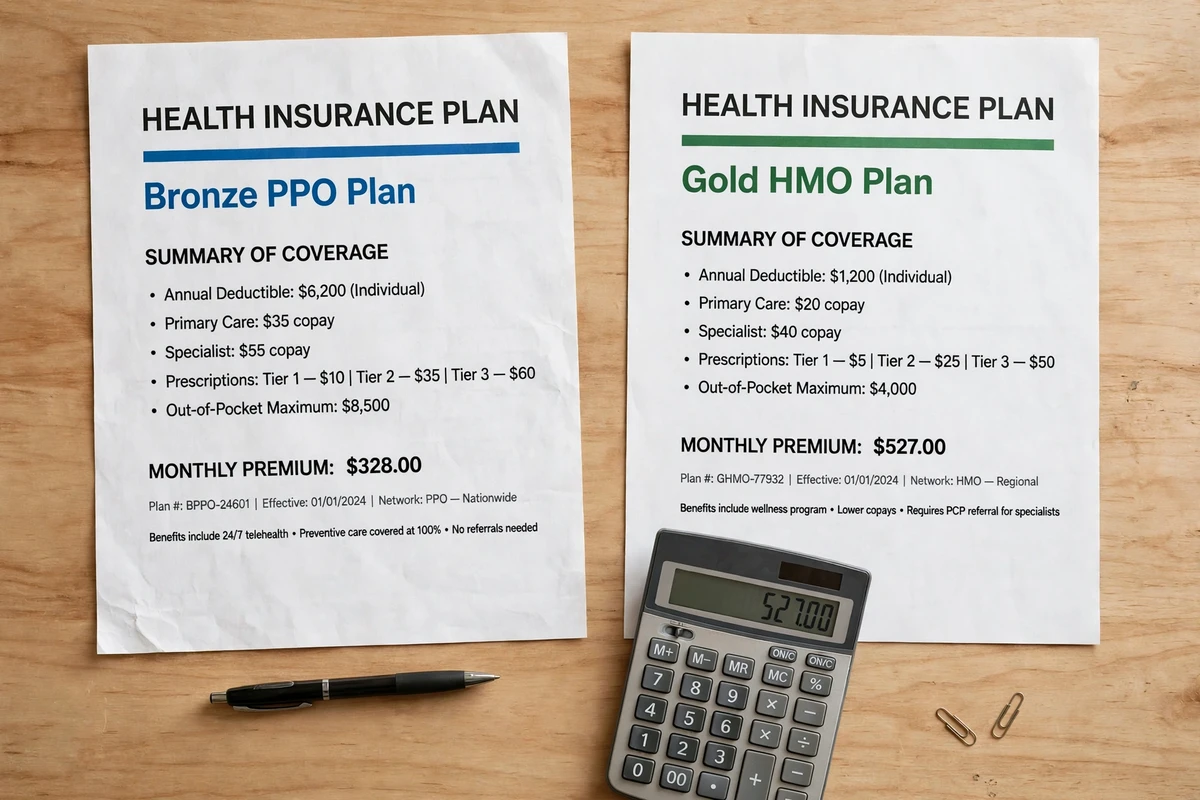
The side-by-side comparison is the fastest way to see the difference. One column is a product built to cover real medical care. The other is a product built to be cheap and temporary.
| Feature | Short-term plan | Marketplace (ACA) plan |
|---|---|---|
| Pre-existing conditions | Can be excluded or denied | Must be covered |
| Essential health benefits | Not required to cover them | Must cover all ten categories |
| Annual or lifetime dollar limits | Allowed; caps as low as $100,000 per term | Not allowed |
| Out-of-pocket maximum | Usually none, or applies only to some costs | Legally capped: $10,600 single / $21,200 family in 2026 |
| Mental health and substance use | Often excluded (40% of plans reviewed) | Must be covered |
| Maternity care | Excluded by 98% of plans reviewed | Must be covered |
| Prescription drugs | Often excluded (48% of plans reviewed) | Must be covered |
| Premium tax credits | Not available | Available for most enrollees |
| Sold on HealthCare.gov | No | Yes |
| Losing the plan opens a Special Enrollment Period | No | Losing other qualifying coverage does |
| Can charge women more than men | Yes | No |
| Maximum term | Depends on your state (3 months on the books; longer where allowed) | Year-long, renews each Open Enrollment |
One row deserves extra attention: the price. The lowest-cost short-term plans can cost two-thirds or less than the lowest-cost unsubsidized Bronze plan in the same area 3. That is a real difference, and it is why these plans sell. But 93 percent of Marketplace enrollees get a premium tax credit, which can make a Marketplace plan similarly priced or even cheaper — and the Marketplace plan covers far more 3. Always compare the price after any subsidy you qualify for, not the sticker price before it 7. A short-term plan cannot be bought with a premium tax credit, and it is not sold on HealthCare.gov or state marketplaces 3.
Who short-term plans suit — and who should avoid them
Short-term plans make sense for a narrow group of people, for a short time, with a clear exit plan. They are a poor fit for everyone else.
They may suit you if you are healthy, take no daily prescriptions, have no chronic condition, and need coverage for a defined gap — for example, you are between jobs and your new employer's coverage starts in two months, or you missed Open Enrollment and need something until the next one. In that case, buy the shortest term that covers your gap, check the exclusions against your actual health needs, and mark the end date on your calendar on the day you buy it.
They do not suit you if you are pregnant or planning to become pregnant, if you take daily prescriptions, if you have a chronic illness such as diabetes or asthma, or if you need mental health care or substance use treatment. In those cases the plan is likely to exclude exactly the care you need, and the money you save on premiums will not cover the bills you pay yourself. They also do not suit you if you cannot afford the deductible and the worst-case costs.
One more warning: do not buy a short-term plan as a permanent replacement for real coverage. It is not built for that. The gaps, the caps, and the lack of a ceiling on your costs make it a bad long-term home for your health care. If you find yourself renewing short-term plans again and again, stop and look at Marketplace options, Medicaid, or employer coverage instead.
What happens when the plan ends
This is the trap that catches the most people. Short-term policies are not "minimum essential coverage," so when one ends mid-year you cannot enroll in a Marketplace plan until the next Open Enrollment 3. Losing a short-term plan does not open a Special Enrollment Period 6.
Think about what that means in real life. You buy a 3-month plan in February. It ends in May. In June you are diagnosed with something serious, or you are injured. You have no coverage, and you cannot buy a Marketplace plan until Open Enrollment, which is months away. Your only options are another short-term plan — which can now deny you because of the new condition — or paying cash. That is the risk you take every time a short-term plan ends.
Plan for the ending before you buy. Know the exact date your coverage stops and what your next coverage will be. If your gap is longer than the plan's term, do not assume you can simply buy another one: the same insurer may count it as a renewal, and a new insurer may deny you for a condition that developed while you were covered. The end date is part of the product. Treat it that way.
How to buy a short-term plan safely
If you decide a short-term plan fits your gap, buy it carefully 4. Use this checklist:
- Confirm it is legal in your state. Short-term plans are banned in California, Illinois, Massachusetts, New Jersey, and New York, and unavailable in nine more states plus Washington, D.C. 3. If a seller offers you one in a ban state, walk away.
- Read the exclusions list. Check maternity, mental health, substance use treatment, prescriptions, and pre-existing conditions against your own health. Do not rely on the sales page. Read the plan document.
- Find the deductible and the benefit cap. Know the deductible you would pay before the plan pays anything, and the maximum the plan will pay per term. If there is no out-of-pocket maximum, assume your costs have no ceiling.
- Check the network. Confirm your doctors and your nearest hospital are in the plan's network. Short-term plans often have narrow networks, and out-of-network care can cost far more.
- Get the term in writing. Ask how long the initial term is, how long the plan can last with renewals, and whether a new policy from the same company within 12 months counts as a renewal.
- Mark the end date and plan the next step. Know what coverage follows this plan, and when it starts. Never let a short-term plan end without a next step already in place.
- Compare against a Marketplace plan after subsidies. Get a Marketplace quote first, with any premium tax credit you qualify for, before you decide the short-term plan is cheaper.
A short-term plan is a bridge. A bridge is useful when you can see the other side. If you cannot see where your next coverage comes from, do not cross it.
Verified against KFF and the Federal Register on November 16, 2026.
The bottom line
Short-term health plans are cheap for a reason: they cover less, they can turn you away for being sick, and they can stop paying when the bill gets big. The 2024 rule that limits them to 3 months is still on the books, but the federal government paused enforcement in August 2025, so what you can buy now depends on your state — and a replacement rule has not yet been finalized. If you are healthy, need a bridge for a few months, and have a clear next step for coverage, a short-term plan can work. If you need real care, take daily medicine, or are pregnant, it is the wrong product. Read the exclusions, find the deductible and the benefit cap, mark the end date, and compare the price against a Marketplace plan after subsidies before you pay anything.
Frequently asked questions
- How long can you have a short-term health plan in 2026?
- The rule on the books says 3 months at a time and 4 months total, counting renewals. But enforcement of that rule has been paused since August 7, 2025, so in states that allow it, insurers are again selling plans with terms of up to 364 days initially and up to 36 months with renewals. What you can buy depends on your state's law, so check the plan's term in writing before you pay.
- Does short-term health insurance cover pre-existing conditions?
- Usually not. Short-term plans are not subject to the federal rule that Marketplace plans must cover pre-existing conditions. They can deny you coverage because of your health history, exclude a condition you already have, or charge you more because of your health.
- What does short-term health insurance not cover?
- It depends on the plan, and the gaps are common. In a KFF review of about 200 short-term plans, 40 percent did not cover mental health services, 40 percent did not cover substance use treatment, 48 percent did not cover outpatient prescription drugs, 94 percent excluded adult immunizations, and 98 percent excluded maternity care. Read the plan's exclusions list before you buy.
- Can I buy a short-term health plan on HealthCare.gov?
- No. Short-term plans are not sold on HealthCare.gov or on state marketplaces, and you cannot use a premium tax credit to pay for one. You buy them directly from an insurer or through a broker.
- What happens when my short-term health plan ends?
- Your coverage simply stops, and losing it does not open a Special Enrollment Period. That means you cannot enroll in a Marketplace plan mid-year just because your short-term plan ended — you wait until the next Open Enrollment, unless a separate qualifying life event, such as losing job-based coverage, applies.
- Is short-term health insurance cheaper than an ACA plan?
- The sticker price often is: the lowest-cost short-term plans can cost two-thirds or less than the lowest-cost unsubsidized Bronze plan in the same area. But 93 percent of Marketplace enrollees get a premium tax credit, which can make a Marketplace plan similarly priced or even cheaper — and the Marketplace plan covers far more. Compare the price after any subsidy, not before it.
Sources
Numbers in the text point to these publications. Links open the original source.
- Federal Register / CMS, HHS, DOL, Treasury. Short-Term, Limited-Duration Insurance and Independent, Noncoordinated Excepted Benefits Coverage; Final Rule (CMS-9904-F), 89 FR 23338
- CMS / HHS. Statement of U.S. Departments of Labor, Health and Human Services, and the Treasury Regarding Short-Term, Limited-Duration Insurance (Aug 7, 2025)
- KFF. Examining Short-Term Limited-Duration Health Plans on the Eve of ACA Marketplace Open Enrollment
- KFF. ACA Open Enrollment: For Consumers Considering Short-Term Policies
- HealthCare.gov (CMS). Out-of-pocket maximum/limit — Glossary
- HealthCare.gov. Special Enrollment Period
- KFF. Marketplace Average Monthly Benchmark Premiums
Related guides
- COBRA Health Insurance: Cost, Deadlines, and When It Is Worth It
COBRA lets you keep your job plan after you leave — but you pay the full premium plus 2%. The 60-day clock, the cost math, and when a Marketplace plan wins.
- ACA Subsidies in 2026: The Enhanced Credits Are Gone — Here's Exactly What You Pay Now (With the $62,600 Cliff in Dollars)
Enhanced ACA credits ended December 31, 2025. In 2026, help stops at $62,600 for one person. See the cliff, the credit math, and the payback trap.
- Health Insurance Open Enrollment 2026–2027: Dates, Deadlines and What to Do If You Miss It
Open enrollment for 2027 runs November 1, 2026 to January 15, 2027. Deadlines, state differences, subsidies, and what to do if you miss it.
This guide is general educational information, not insurance, legal or financial advice. Insurance rules and prices vary by state, company and personal circumstances. Confirm anything important with your state insurance department or a licensed professional. Read the full disclaimer.